Modi Pushes BRICS Toward Reform and Greater Continuity
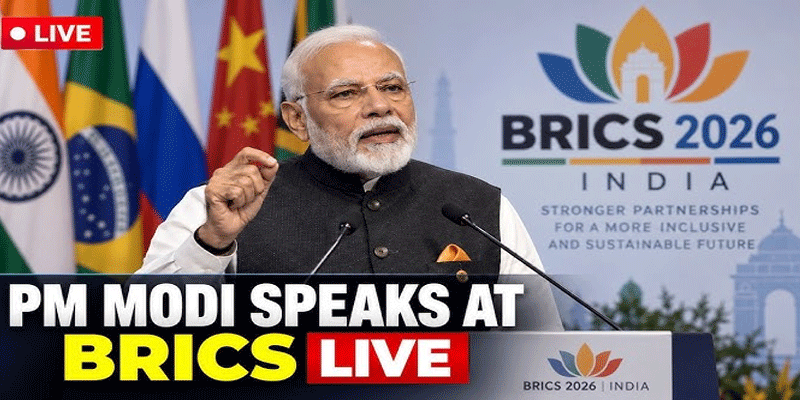
Prime Minister Narendra Modi opened the 18th BRICS Leaders’ Summit in New Delhi with a forceful call for urgent reform of the United Nations Security Council and a new continuity mechanism for BRICS. With Chinese President Xi Jinping, Russian President Vladimir Putin and leaders and senior representatives of the expanded grouping present, India is seeking to give its BRICS chairmanship a practical institutional direction while amplifying the voice of the Global South.
Reforming Global Governance
Modi’s demand for faster UNSC reform comes against a backdrop of wars in Ukraine and West Asia, trade tensions, sanctions, energy disruptions and growing competition over artificial intelligence and digital infrastructure. India has long argued that the Security Council’s structure reflects a bygone international order and does not adequately represent today’s economic and demographic realities.
For New Delhi, the issue is both national and collective. A stronger voice for Asia, Africa and Latin America would align with India’s aspiration for a greater role in global decision-making while addressing the wider concerns of developing economies. With 11 members representing roughly 49% of the global population and about 40% of global GDP, BRICS has considerable weight, although its members differ sharply on foreign policy and economic priorities.
Building Continuity Within BRICS
Modi’s proposal for a BRICS continuity mechanism addresses another challenge: the annual rotation of the presidency can disrupt institutional momentum. A stronger framework could preserve initiatives across successive presidencies through multi-year work plans, progress reviews, coordinated ministerial programmes and mechanisms to monitor summit commitments.
Such an arrangement could make BRICS more effective without necessarily turning it into a rigid bureaucracy. The challenge will be finding a balance between institutional continuity and the flexibility that has traditionally defined the grouping.
Digital Cooperation as a Practical Frontier
Technology and digital cooperation are emerging as important areas for India’s BRICS agenda. Modi has called for a secure digital ecosystem, while discussions have increasingly focused on interoperable payment systems, local-currency trade and digital finance.
India’s experience with the Unified Payments Interface provides a potential model for cross-border payment cooperation. Yet creating a common BRICS financial architecture will require addressing differences in regulations, currencies, cybersecurity standards and data governance. Practical cooperation on payment interoperability, fraud prevention and secure data exchange could therefore prove more achievable than an immediate common currency.
Xi and Putin Add Diplomatic Weight
The presence of Xi and Putin significantly raises the summit’s strategic importance. Xi’s first India visit in seven years comes amid a cautious improvement in India-China relations following years of border tensions. Putin’s participation reinforces the continuing importance of the India-Russia relationship across defence, energy, trade and technology.
India is consequently using the summit to manage several relationships simultaneously—engaging China, maintaining strategic ties with Russia, strengthening its Global South leadership and retaining productive partnerships with the United States and Europe.
The Challenge of Holding BRICS Together
BRICS’ expansion has increased its global reach but also complicated consensus. The grouping includes India and China despite their strategic rivalry, Russia and Iran amid Western sanctions, and Gulf countries that maintain important relationships with the United States and Europe.
India’s preferred approach is therefore to make BRICS non-Western rather than anti-Western. New Delhi wants strategic autonomy, diversified partnerships and greater representation rather than a new geopolitical bloc defined by confrontation.
From Global Ambition to Institutional Delivery
Modi’s opening message places representation, continuity and practical cooperation at the centre of India’s BRICS presidency. The real measure of success, however, will be whether these ambitions produce measurable outcomes.
If BRICS can sustain initiatives across presidencies, improve digital and financial connectivity and build consensus around reform of global institutions, its growing economic weight can translate into genuine influence. India’s challenge is to turn Global South solidarity into durable institutions—and diplomatic declarations into collective action.
(With inputs from agency)