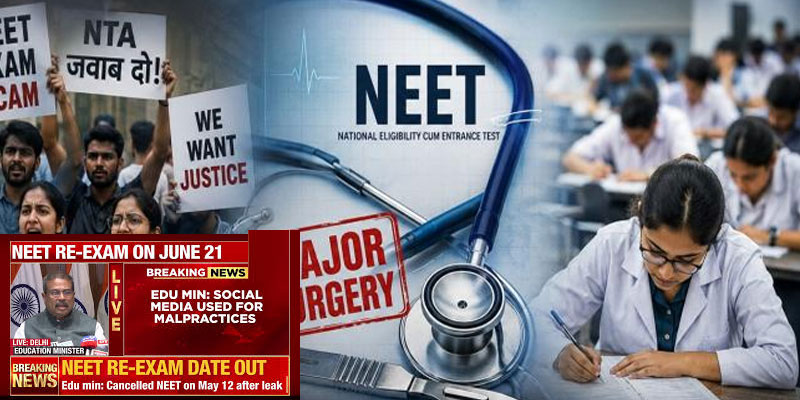
The Centre on Friday formally acknowledged a breach in the command chain of the NEET-UG 2026 examination, with Union Education Minister Dharmendra Pradhan accepting responsibility on behalf of the Education Ministry and announcing a series of corrective measures. Addressing a press conference amid growing outrage over the alleged paper leak, Pradhan confirmed that the National Eligibility cum Entrance Test (NEET-UG) had been cancelled after evidence of the leak surfaced, and said a fresh examination would now be conducted in June under tighter security protocols.
The announcement comes as lakhs of medical aspirants across the country grapple with uncertainty after one of India’s most competitive entrance examinations was compromised. Nearly 23 lakh students appear for NEET every year, making it the single gateway to undergraduate medical and dental admissions nationwide.
What Dharmendra Pradhan Said During the Press Conference
During the briefing, Pradhan admitted that there had been a serious lapse in the examination system and said the government was taking “moral and administrative responsibility” for the breach. He assured students and parents that strict action would be taken against everyone involved, including insiders if their role was established.
The minister stated that affected candidates would not need to re-register for the fresh examination. Instead, they would receive fresh admit cards by June 14, while city intimation slips would be released after May 20. Students would also be allowed to choose their preferred examination city again in an attempt to reduce logistical stress.
Pradhan appealed to students not to panic or believe rumours circulating online, emphasizing that the government’s immediate priority was to conduct a secure and transparent re-exam. He also reiterated that the investigation had been handed over to the Central Bureau of Investigation and promised a “thorough and smooth” probe into the larger conspiracy.
CBI Probe and Allegations Against NTA Insiders
The scandal deepened after the CBI informed a Delhi court that the paper leak appeared to originate from within the National Testing Agency itself. Investigators believe the examination paper was accessed through a Pune-based intermediary before being circulated to multiple groups.
According to officials, the leaked PDF “guess paper” reportedly matched around 120 out of 180 questions in the actual examination, including an exact match of 120 Chemistry questions. The scale of similarity triggered immediate concerns over the integrity of the examination process and eventually led to the cancellation decision.
The CBI has already conducted raids at 14 locations and recovered digital evidence and deleted data now undergoing forensic analysis. Investigators are also examining the role of printing vendors, distribution channels and internal officials linked to the paper’s movement.
A Systemic Failure Under Political Scrutiny
The controversy has reignited criticism of the NTA’s handling of high-stakes national examinations. Opposition parties and student groups have questioned the agency’s secrecy protocols and demanded institutional reforms.
The issue has also revived attention on the Public Examination Act, 2024, under which paper leaks are treated as non-bailable offences. Analysts argue that while the government’s decision to acknowledge the breach publicly may help contain political damage, restoring public trust will require more than a re-exam.
Restoring Credibility Will Be the Real Test
The government now faces a difficult balancing act — conducting a fair re-examination within weeks while simultaneously rebuilding confidence in India’s examination system. The immediate challenge is logistical, but the larger challenge is institutional credibility.
The NEET-UG crisis has exposed vulnerabilities in exam security, supply-chain management and oversight mechanisms. Whether the government succeeds in restoring trust will depend not only on punishing those responsible, but also on implementing durable reforms that prevent such failures from recurring in the future.
(With agency inputs)