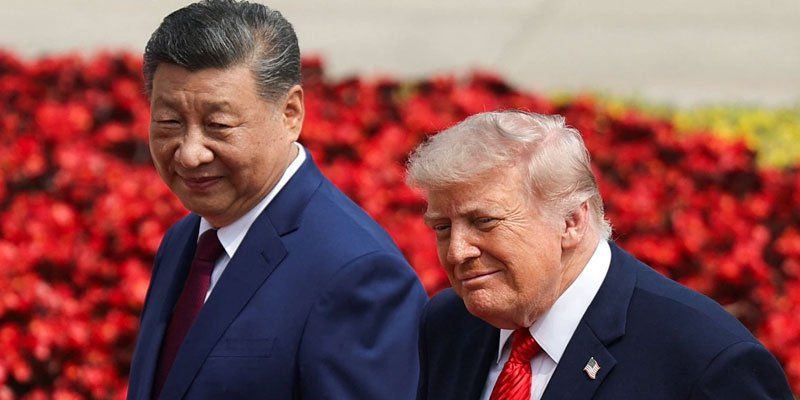
The summit between US President Donald Trump and Chinese President Xi Jinping produced a rare moment of strategic convergence between Washington and Beijing on two of the world’s most volatile geopolitical issues: the Strait of Hormuz and Iran’s nuclear ambitions. Both leaders agreed that the Strait of Hormuz must remain open to ensure uninterrupted global energy flows and reiterated that Iran should never acquire a nuclear weapon.
At a time of rising tensions in the Middle East and growing US-China rivalry, the summit signalled a limited but important diplomatic alignment on global security and economic stability.
Hormuz Emerges as a Shared Strategic Concern
According to the White House readout, both sides emphasized that the Strait of Hormuz must remain open to support the free flow of energy supplies. The narrow waterway is among the world’s most critical energy chokepoints, carrying nearly 20 percent of global crude oil and natural gas shipments.
Xi reportedly opposed any militarisation of the strait or the imposition of transit tolls, reflecting China’s deep dependence on stable energy imports. Beijing also indicated interest in increasing purchases of American oil as part of a broader effort to diversify supply chains and reduce strategic vulnerability linked to Hormuz.
The discussion highlighted how energy security is increasingly intertwined with diplomacy and global trade calculations. For Washington, ensuring open sea lanes supports international economic stability; for Beijing, it reduces exposure to regional instability and geopolitical pressure.
Consensus on Iran’s Nuclear Programme
One of the summit’s most closely watched outcomes was the reaffirmation by both leaders that Iran must never possess a nuclear weapon. This marked a significant point of agreement between two powers often divided on international security matters.
Trump also claimed that Xi assured him China would not provide military equipment to Iran during the ongoing Middle East conflict. Calling it a “big statement,” Trump suggested such a commitment could contribute to reducing regional escalation and limit battlefield intensification.
However, analysts caution that while the declaration is diplomatically significant, it does not automatically translate into stronger Chinese pressure on Tehran. China maintains substantial economic ties with Iran and has historically balanced strategic interests carefully in the region.
Economic Cooperation and Diplomatic Reset
Beyond security, the summit attempted to frame US-China relations around pragmatic cooperation. Both sides discussed reducing fentanyl precursor flows into the United States and expanding Chinese purchases of American agricultural products.
Trump described the talks as “extremely positive and productive,” praising Xi for what he called a “magnificent welcome.” Xi, in turn, proposed that China’s vision of “Great Rejuvenation” and America’s “MAGA” agenda could coexist and complement each other economically.
The rhetoric suggested an effort to soften tensions and portray bilateral engagement as mutually beneficial despite years of trade disputes and technological rivalry.
Taiwan Remains the Major Flashpoint
Despite cooperation on Iran and Hormuz, Xi made it clear that Taiwan remains the most sensitive issue in US-China relations. Beijing reiterated that the cross-strait question sits at the centre of its national interests and warned Washington against actions perceived as undermining Chinese sovereignty claims.
The warning underscored the limits of the summit’s diplomatic breakthrough. While both powers found common ground on Middle East stability, structural rivalry over Taiwan, advanced technology and military influence in Asia remains unresolved.
A Narrow Breakthrough Amid Deeper Rivalry
The Trump-Xi summit demonstrated that Washington and Beijing can still cooperate selectively when global stability and economic interests align. Their shared position on Hormuz and Iran represents a meaningful, high-stakes consensus at a fragile geopolitical moment.
Yet the broader relationship remains shaped by mistrust and strategic competition. The summit may ease tensions temporarily, but lasting stability will depend on whether both sides can manage deeper disagreements — particularly over Taiwan — without allowing rivalry to overwhelm cooperation.
(With agency inputs)