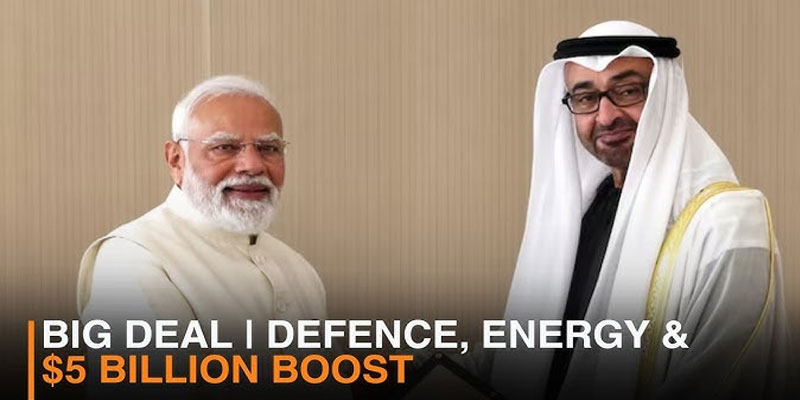
Prime Minister Narendra Modi made a brief but strategically significant stop in the United Arab Emirates during his five-nation diplomatic tour, securing key agreements on energy security and defence cooperation at a time of growing instability in West Asia. India and the UAE signed major memoranda of understanding covering long-term liquefied petroleum gas (LPG) supply, strategic petroleum reserves (SPR), and an expanded framework for strategic defence collaboration.
Though short in duration, the visit carried considerable geopolitical weight as global oil markets remain tense amid fears over disruptions in the Strait of Hormuz and the continuing fallout of the US–Israel conflict with Iran. The agreements underline India’s effort to secure critical energy supplies while simultaneously strengthening strategic ties with one of its most dependable Gulf partners.
LPG and Petroleum Reserve Agreements Take Centre Stage
Energy security emerged as the central focus of the visit. The UAE currently ranks as India’s largest LPG supplier, accounting for nearly 26 to 40 percent of India’s total imports. The newly signed LPG memorandum aims to ensure long-term supply stability, reduce exposure to volatile international markets and guarantee uninterrupted cooking fuel availability for Indian households.
The second agreement relates to India’s strategic petroleum reserve programme. Under the pact, the UAE is expected to expand its participation in India’s SPR infrastructure through possible storage commitments and long-term supply arrangements. This is particularly important as concerns persist over the Strait of Hormuz, one of the world’s most vital energy transit corridors.
With nearly a fifth of global oil shipments moving through Hormuz, any prolonged disruption could sharply impact India’s import-dependent energy economy. The UAE’s role as a reliable supplier therefore gains greater strategic significance during periods of regional uncertainty.
Visit Comes Amid Global Energy Anxiety
Modi’s visit took place against the backdrop of an intensifying global energy crisis triggered by geopolitical tensions in West Asia. Rising fears over supply-chain disruptions and fluctuating crude oil prices have compelled major energy-importing nations to secure alternative buffers and stable partnerships.
During meetings in Dubai, discussions reportedly focused not only on energy cooperation, but also on trade, investment and broader economic connectivity. The UAE has emerged as one of India’s most important economic partners in the Gulf region, with bilateral ties expanding rapidly across infrastructure, technology and logistics sectors.
Expanding Defence and Security Cooperation
Alongside energy agreements, India and the UAE also moved forward on a Strategic Defence Partnership framework. The initiative builds upon the 2026 letter of intent signed during UAE President Mohamed bin Zayed Al Nahyan’s visit to India.
The proposed framework will cover defence industrial collaboration, cybersecurity, advanced technologies, counter-terrorism coordination and military training. Officials indicated that future cooperation may include joint exercises, special operations coordination, interoperability initiatives and defence innovation partnerships.
The defence partnership is also expected to create opportunities for co-production, technology transfer and collaborative research programmes between the two countries.
Strategic Alignment Beyond Immediate Agreements
Modi also condemned attacks targeting the UAE and reiterated India’s support for regional peace and stability. His remarks reflected India’s broader diplomatic approach of strengthening reciprocal security partnerships while maintaining stable relations across the Gulf region.
The agreements collectively represent more than isolated economic arrangements. They indicate a deeper strategic alignment in which India seeks to diversify its energy sources, build resilience against external shocks and enhance defence cooperation with trusted regional partners.
Compact Visit, Long-Term Strategic Gains
Despite its brief duration, Modi’s UAE stop delivered substantial strategic outcomes. The LPG and petroleum reserve agreements directly address India’s growing energy vulnerabilities, while the defence framework signals a widening security partnership with a key Gulf ally.
As global uncertainty continues to reshape energy and geopolitical calculations, India’s engagement with the UAE reflects a pragmatic strategy focused on resilience, diversification and long-term strategic stability.
(With agency inputs)