From Rourkela Innovation to a ₹66-Crore Navy Deal
Coratia Technologies, a Rourkela-based underwater-robotics startup, has emerged as an important example of India’s growing indigenous defence-tech capability after securing a ₹66-crore Indian Navy contract. Importantly, the contract was announced in September 2025, rather than being a fresh deal this week. Its significance lies in what it represents: an Odisha-born deep-tech company moving from university incubation and prototypes to deploying mission-critical technology for India’s armed forces.
A Startup Born from NIT Rourkela
Its focus is a particularly challenging segment of robotics. Underwater machines must operate in darkness, high pressure, strong currents and environments where conventional communication and navigation are difficult. Historically, such operations have depended heavily on divers or imported equipment.
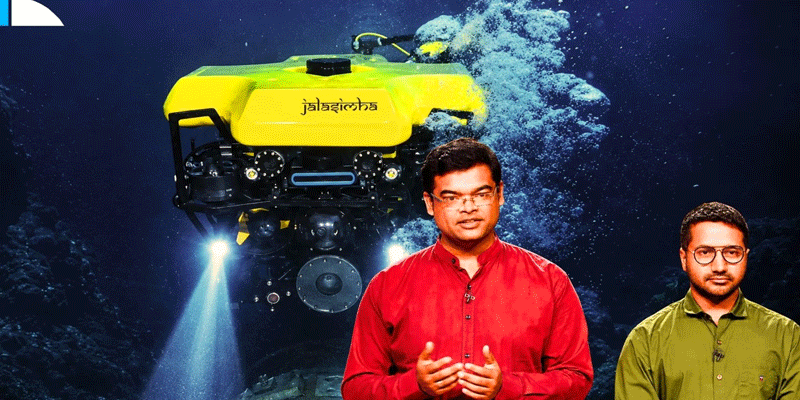
Coratia's approach is to combine remotely operated vehicles (ROVs), autonomous underwater vehicles and autonomous surface vessels. Its platforms include JalaDuta, JalaSimha, Oceanaus and Navya, equipped with cameras, sonar, positioning systems and data capabilities for underwater inspection and surveying.
From Civilian Infrastructure to Naval Operations
The technology has applications well beyond defence. Underwater robots can inspect dams, bridge foundations, ports, ship hulls, pipelines, offshore energy installations and subsea communication infrastructure.
That has considerable commercial value. A robot can inspect a bridge foundation after extreme weather, examine corrosion on a pipeline or survey a reservoir without immediately exposing divers to dangerous conditions. More frequent robotic inspections can also create digital records that support predictive maintenance and reduce the risk of infrastructure failures.
This civilian experience can become a crucial foundation for defence applications, where reliability and data quality matter even more.
Why the Navy Contract Matters
The ₹66-crore Navy order covers the supply and servicing of indigenous underwater remotely operated vehicles. Coratia has described the contract as a major induction of Indian-built UWROVs into naval operations. Its JalaSimha platform is designed for tasks including underwater inspection and maintenance, seabed and harbour surveys, minor salvage operations and examination of submerged infrastructure.
The project is connected to the Ministry of Defence’s Innovations for Defence Excellence (iDEX) framework, which seeks to connect startups, MSMEs and innovators with military requirements and accelerate indigenous defence solutions. Coratia received support under the Defence India Startup Challenge programme.
Odisha’s Deep-Tech Opportunity
Coratia’s journey is significant for Odisha as much as for India’s defence ecosystem. It demonstrates how universities; incubation centres and government innovation programmes can create pathways from academic engineering to strategic technology.
Underwater robotics also fits into India’s wider maritime ambitions, including naval modernisation, port development, subsea infrastructure protection and the emerging blue economy.
The Real Test Begins After the Contract
The Navy order establishes credibility, but it is not the finish line. Coratia will now have to demonstrate naval-grade reliability, maintainability, cybersecurity, operator training and sustained performance in demanding environments.
The larger opportunity is to develop an indigenous ecosystem around underwater sensors, navigation, software, batteries and subsea communications rather than merely manufacture individual robots.
From Contract to Strategic Capability
Coratia’s story illustrates what India’s defence-startup ecosystem is trying to achieve: turning local engineering talent into deployable strategic capability. For Odisha, it offers an equally powerful message—that cutting-edge deep technology need not emerge only from traditional technology hubs.
The ₹66-crore order is therefore more than a commercial milestone. Its real success will be measured when an Odisha-built underwater robot repeatedly performs where human access is difficult, imported technology is costly and operational failure is unacceptable. That is when a promising startup becomes a genuine pillar of India’s maritime technology ecosystem.
(With agency inputs)