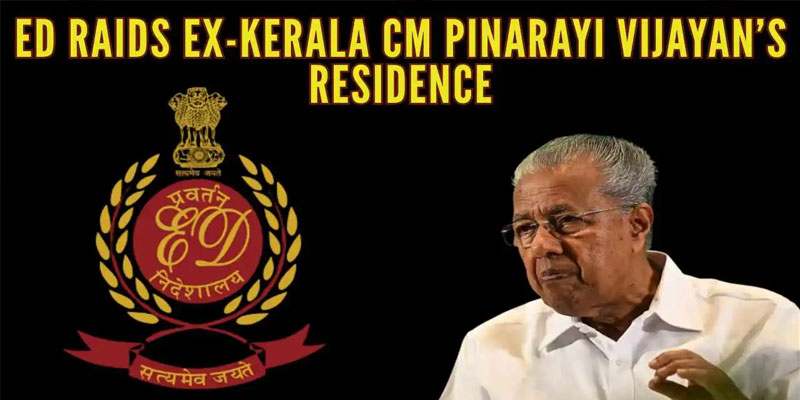
A major political storm broke out in Kerala after Enforcement Directorate (ED) teams conducting searches linked to former Chief Minister Pinarayi Vijayan and his family came under attack during state-wide protests by workers of the Communist Party of India (Marxist). Demonstrators reportedly blocked and vandalised an ED vehicle, smashing its windows and demanding that the agency halt its investigation. The protests erupted after the ED carried out raids at multiple locations connected to Vijayan and his family in connection with an alleged money-laundering probe, turning a legal investigation into a major political confrontation.
The Raids and the Alleged Financial Transactions
The Enforcement Directorate conducted searches at around ten locations across Kerala and beyond as part of its investigation into alleged financial dealings involving Cochin Minerals & Rutile Ltd (CMRL) and Exalogic Solutions, a company associated with Vijayan’s daughter, Veena Vijayan.
Among the premises searched were Vijayan’s rented residence in Thiruvananthapuram, his ancestral home in Kannur, properties linked to family members, and the Bengaluru office of Exalogic Solutions. The probe centers on allegations that payments amounting to approximately ₹1.72 crore were made by CMRL to Exalogic Solutions between 2017-18 and 2019-20.
According to reports, ED officials also recorded statements as part of the ongoing investigation while central security personnel maintained a strong presence during the searches.
Protests Turn Aggressive
The raids triggered immediate protests from CPI(M) workers and supporters across the state. Hundreds gathered outside Vijayan’s residence and at several district headquarters, accusing the central government of misusing investigative agencies against opposition leaders.
The agitation intensified when protesters allegedly obstructed an ED vehicle and damaged it during demonstrations. Images and videos of the vandalised vehicle quickly circulated, further escalating the political temperature.
While party leaders defended the right to protest, the attack on a central agency vehicle drew criticism and raised concerns about the increasingly confrontational nature of political mobilization around investigations involving senior leaders.
CPI(M)’s Charge of Political Vendetta
The CPI(M) strongly condemned the raids, describing them as politically motivated and part of a broader pattern of targeting opposition parties through central agencies.
Senior leaders argued that agencies such as the ED, CBI, and Income Tax Department are increasingly being deployed against political rivals of the ruling establishment at the Centre. They portrayed the action as an attempt to tarnish Vijayan’s image and weaken the opposition.
The controversy gained additional significance because it came shortly after the Kerala High Court declined to interfere with aspects of the ED’s ongoing probe, effectively allowing the investigation to proceed.
Beyond the Investigation: A Federal and Political Clash
The episode highlights the growing friction between opposition-ruled states and the Centre over the role of investigative agencies. Increasingly, legal probes are being interpreted through a political lens, with allegations of selective targeting becoming common across party lines.
For supporters of the investigation, the ED is carrying out its statutory responsibilities under anti-money-laundering laws. For critics, the timing and intensity of such actions raise questions about political intent.
Law, Politics and Public Trust
The Kerala episode underscores how investigations involving prominent political figures can rapidly evolve into wider battles over federalism, accountability, and institutional credibility. While the ED’s probe will ultimately be judged on evidence and legal outcomes, the violent protests reveal the deep mistrust that now surrounds high-profile investigations. As the case progresses, both the integrity of the legal process and the conduct of political actors will be closely scrutinized, making this more than just a corruption inquiry—it is also a test of democratic institutions and public confidence in them.
(With agency inputs)