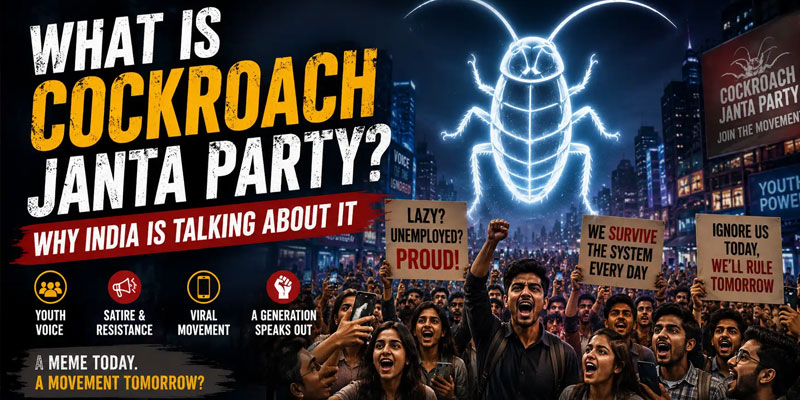
The Cockroach Janta Party (CJP) began as an internet joke but quickly evolved into one of the most talked-about political phenomena on Indian social media. What started as a satirical response to a controversial “cockroach” remark about unemployed youth soon transformed into a viral movement that tapped into broader frustrations over jobs, governance, and political accountability. Though not a registered political party, CJP has demonstrated how memes, satire, and digital activism can create a powerful political narrative in a hyper-connected society.
How the Cockroach Janta Party Was Formed
The Cockroach Janta Party was launched on May 16, 2026, by Abhijeet Dipke, a U.S.-based political communications strategist and former aide associated with the Aam Aadmi Party. The initiative emerged after a controversy surrounding remarks attributed to Chief Justice Surya Kant, which sparked debate over the treatment and perception of unemployed youth. CJP adopted the “cockroach” label ironically, turning it into a symbol of resistance and collective frustration among young Indians.
What distinguished the movement was its ability to blend humour with political messaging. Through memes, viral videos, and online campaigns, the platform attracted large numbers of followers within days and became a prominent topic across social media platforms. Reports indicated that its rapid rise generated extraordinary engagement, particularly among younger internet users.
Who Is Behind the Movement?
Unlike conventional political parties built around formal structures, CJP is largely a digital-first movement centered around Dipke and a network of online supporters. Its popularity has been driven less by traditional organization and more by grassroots social-media participation.
The movement portrays itself as a voice for unemployed youth and citizens disillusioned with mainstream politics. Its messaging combines satire with criticism of political institutions, media narratives, and governance issues, allowing it to resonate with sections of the population that feel underrepresented in conventional political discourse.
What Are Its Objectives?
Although presented humorously, CJP has articulated several policy-oriented demands. These include greater political accountability, stronger representation of women in governance, stricter action against political defections, and enhanced transparency in public institutions.
The movement has also expressed support for youth-centric causes, including concerns related to examinations, education policies, and employment opportunities. In this sense, CJP functions as both a satirical brand and a platform through which broader social grievances are amplified. Its appeal lies in transforming frustration into a form of political participation that is accessible, humorous, and highly shareable.
Government Response and Efforts to Curb Its Reach
The government has not treated the phenomenon merely as online comedy. In May 2026, CJP’s official X account was withheld in India following directions linked to concerns raised by authorities. Reports indicated that the action was taken after inputs citing national-security and sovereignty-related concerns.
Subsequently, the movement alleged that several associated social-media accounts faced restrictions, suspensions, or hacking attempts. Reports also suggest that its website and other digital channels encountered access-related challenges.
Is CJP Still Active?
Despite restrictions on some platforms, CJP remains active as an online movement. Its X presence has faced limitations within India, but alternative accounts and international access have helped sustain visibility. Meanwhile, its Instagram ecosystem and supporter-generated content continue to circulate widely, keeping the brand relevant in digital conversations.
A New Form of Political Expression
The rise of the Cockroach Janta Party illustrates how political engagement is evolving in the digital age. Whether viewed as satire, protest, or an emerging political experiment, CJP has shown that online communities can rapidly transform cultural moments into influential public movements. While its long-term impact remains uncertain, its success underscores a growing reality: in contemporary politics, memes and social media can sometimes shape public discourse as effectively as traditional political organizations.
(With agency inputs)