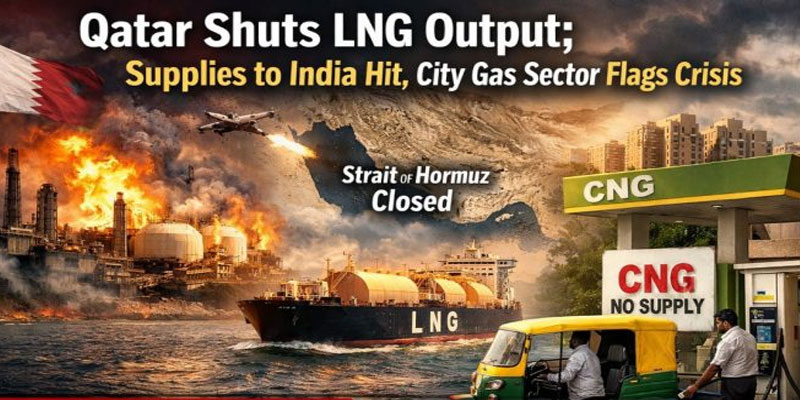
Qatar is facing a deepening economic and energy crisis as geopolitical tensions in West Asia disrupt liquefied natural gas (LNG) exports, damage critical infrastructure and threaten global energy security. The situation has serious implications for India, which has historically depended heavily on Qatari gas.
Qatar's government revenues declined by 42% during the first half of 2026, according to Emir Sheikh Tamim bin Hamad Al Thani. The decline reflects disruptions caused by the regional conflict, restrictions on shipping through the Strait of Hormuz and damage to energy infrastructure at Ras Laffan.
Key facts
-
42% decline: Qatar's governmen
t revenue in the first half of 2026, not its LNG production. -
17% capacity loss: Reported da
mage to Qatar's LNG export inf rastructure. -
41% dependence: Qatar's share
of India's LNG imports in FY20 24–25. -
India's response: Alternative
LNG sourcing and priority allo cation for essential sectors.
The crisis has also affected Qatar's LNG production capacity. Iranian strikes reportedly damaged facilities representing approximately 17% of its export capacity, creating potentially prolonged supply constraints. Qatar remains a major global LNG exporter, making disruptions particularly significant for energy-importing economies.
India faces considerable exposure. During 2024–25, Qatar supplied approximately 41% of India's LNG imports, equivalent to 11.2 million tonnes. This dependence made the country vulnerable to interruptions in shipments and rising international gas prices.
However, India's response demonstrates growing energy resilience. The government introduced emergency gas-allocation measures earlier in the crisis, prioritising households, transport and fertiliser production while managing supplies to industrial consumers.
India has also diversified LNG procurement towards the United States, Oman and Nigeria. Recent industry data indicates that these alternative sources helped offset reduced Qatari and UAE shipments, allowing India's overall LNG imports to grow despite continuing regional disruptions.
The larger concern is the economic impact of expensive energy. Higher LNG prices can increase fertiliser production costs, industrial operating expenses and electricity-generation costs, potentially creating inflationary pressure across the economy.
Looking ahead, India must strengthen long-term energy security through diversified contracts, additional import infrastructure, strategic planning and domestic energy development. The Qatar crisis demonstrates that energy security is no longer simply about securing supplies at competitive prices—it is about maintaining economic stability during prolonged geopolitical disruptions.