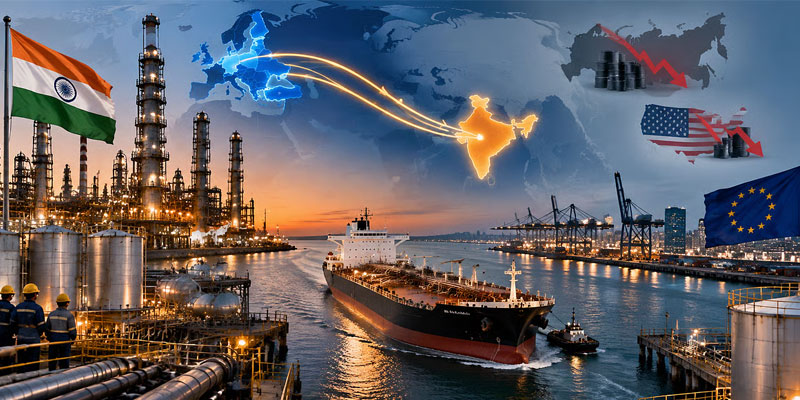
India’s pivot to discounted Russian crude since 2022 has created a new class of corporate winners, with private energy giants reaping billions in extra profits. The shift followed Western sanctions on Moscow after its invasion of Ukraine, which diverted Russian oil to Asian markets at steep discounts. India, now one of the largest buyers, imported nearly $140 billion worth of Russian crude over two years, up from negligible levels pre-war.
At the forefront is Mukesh Ambani’s Reliance Industries, operating the world’s largest single-site refinery in Jamnagar, Gujarat. Russian crude now makes up nearly 30% of its daily processing of 1.4 million barrels. Reliance secured a 10-year supply deal with Rosneft in 2024 for 500,000 barrels per day, set to rise to 700,000 in 2025. Analysts estimate Reliance alone has pocketed $6 billion in additional profit, part of the $16 billion windfall for Indian refiners.
Nayara Energy, backed by Rosneft and Trafigura, and state-run refiners like IOC and BPCL have also capitalized, blending cheap Russian feedstock with higher-priced exports of refined fuels to global markets. The profit margins are particularly lucrative for private players, who are less constrained by domestic pricing controls.
However, the boom faces headwinds. The U.S. has grown increasingly critical, with President Donald Trump imposing 50% tariffs on certain Indian goods, citing indirect funding of Russia’s war effort. Potential tightening of sanctions or price-cap enforcement could erode margins. Domestically, high retail fuel prices are prompting calls from ministers like Nitin Gadkari to accelerate ethanol adoption, which could reshape demand dynamics.
For now, Russian oil remains central to India’s energy strategy, balancing affordability with geopolitical tightrope walking. Tycoons like Ambani have positioned themselves at the intersection of global energy flows and trade politics—profiting handsomely, but exposed to shifting diplomatic and regulatory currents.