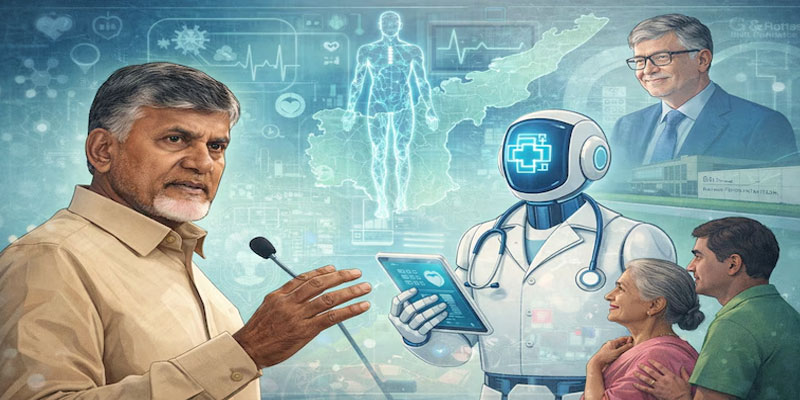
Andhra Pradesh Chief Minister N. Chandrababu Naidu introduced a revolutionary—and controversial—proposal: a "One AI Doctor Per Person" model. Announced as part of the statewide expansion of the Sanjeevani digital health project, the plan aims to assign a dedicated AI health assistant to every citizen to track real-time health data and provide personalized preventive care.
The initiative, supported by the Bill & Melinda Gates Foundation, intends to create comprehensive digital health records for the state's five crore residents within a year.
The core philosophy behind the "AI Doctor" is a shift from reactive medicine to proactive, preventive care. CM Naidu argued that AI can effectively monitor lifestyle diseases, which currently account for a massive portion of healthcare spending.
- Real-Time Coaching: The AI doctor would act as a 24/7 health coach, using data from wearables and mobile devices to offer guidance on diet, physical activity, and sleep.
- Early Detection: By analyzing a person's digital nerve center, the system can flag early signs of the state's "top ten" prevalent diseases, including diabetes, hypertension, and cardiac issues.
- Economic Impact: The government estimates that this predictive monitoring could reduce the state's health budget by a projected ₹5,000 crore by minimizing the need for expensive late-stage treatments.
While technologists have lauded the proposal as a "game changer" for the Global South, it has sparked a fierce debate regarding data privacy and consent.
- "Total Surveillance" Concerns: Critics on social media and civil society groups argue that continuous health tracking constitutes a form of "biometric surveillance." They question who will own the data and whether insurance companies could use "lifestyle scores" to hike premiums.
- Informed Consent: A recent study presented at the AI Impact Summit 2026 raised alarms about whether rural and disadvantaged populations can truly provide "informed" consent for their data to be used in AI training models.
- Security Risks: Analysts warn that a centralized database of five crore citizens' health markers—everything from DNA sequences to daily heart rates—would be a primary target for model extraction and data theft attacks.
The project is currently being piloted in Kuppam and Chittoor, where the "Sanjeevani" platform has already integrated primary health center data.
|
Milestone |
Expected Completion |
|
Digitization of 5 Crore Records |
December 2026 |
|
AI Doctor Prototype Rollout |
Early 2027 |
|
Integration with WhatsApp Governance |
June 2026 |
Export to Sheets
Chief Minister Naidu has positioned this as part of a broader "One Family, One AI" policy, aiming to make Andhra Pradesh the world’s most tech-integrated "Knowledge Economy."
The Andhra proposal is the ultimate test of the "Trust Gap" in AI. While it promises to democratize world-class medical advice for the poor, it requires citizens to trade total medical transparency for better health outcomes. As New Delhi hosts the Global AI summit this week, the Andhra model is being watched as either a blueprint for the future or a cautionary tale of over-automation.
Chandrababu Naidu on AI as a Game Changer
In this video from BTDavos 2026, the Chief Minister explains his broader vision for integrating real-time health data and AI into governance to improve last-mile delivery.