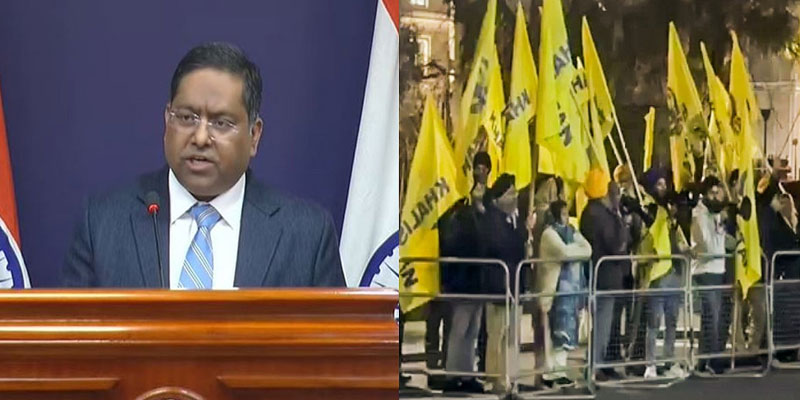
A New Line Drawn in London
The UK’s latest sanctions on Khalistani-linked actors represent one of the clearest signals yet that London is prepared to confront extremist networks operating within its borders. For India, long frustrated by what it saw as permissiveness toward diaspora-driven radicalism, this is a concrete corrective—an overdue shift from rhetoric to enforcement. The decision, which targets both individuals and organisations tied to pro-Khalistan militancy, marks a recalibration in how Britain interprets the security risks emanating from extremist platforms claiming to represent Sikh political interests.
What Triggered the Action
Under its new Domestic Counter-Terrorism Regime, the UK Treasury imposed an asset freeze and a director-level ban on British Sikh businessman Gurpreet Singh Rehal, citing reasonable suspicion of links to groups involved in terrorism in India. Simultaneously, Babbar Akali Lehar was sanctioned for enabling or promoting the proscribed Khalistani outfit Babbar Khalsa, cutting it off from UK-regulated funds and financial systems.
India welcomed the move immediately. The Ministry of External Affairs framed the decision as strengthening global counter-terror norms and curbing illicit financial channels that allow transnational terror networks to persist. For New Delhi, the sanctions also validate years of diplomatic pressure over UK-based platforms accused of orchestrating online radicalisation, attacks on diplomatic facilities, and fundraising for banned groups.
Historical Roots: From Babbar Khalsa to Babbar Akali Lehar
Babbar Khalsa: Violence Across Borders
Babbar Khalsa International (BKI) is among the most notorious Khalistani terrorist groups. Emerging from the violent turbulence of late-1970s Punjab, BKI played a central role in the insurgency of the 1980s. Its most infamous act—the 1985 bombing of Air India Flight 182, which killed 329 people—is one of the deadliest acts of aviation terrorism in history. Linked operatives were also blamed for the Narita airport blast the same day, the assassination of Punjab Chief Minister Beant Singh in 1995, and the 2005 Delhi cinema bombings.
Listed as a terrorist organisation across major Western nations, BKI’s surviving elements operate largely through diaspora-based fundraising, propaganda networks, and covert recruitment pipelines.
Babbar Akali Lehar: Ideology Repurposed
Babbar Akali Lehar borrows its name and symbolism from the militant Babbar Akali movement of the 1920s—an anti-colonial faction that rejected peaceful activism and targeted British collaborators in Punjab. While today’s iteration is not tied to a known attack record, UK authorities classify it as part of an enabling ecosystem for Babbar Khalsa: a historical banner repurposed to provide legitimacy, financial channels or ideological cover to a proscribed militant outfit.
Implications and the Road Ahead
Britain’s sanctions are more than administrative penalties—they signal a strategic shift. They acknowledge that extremist financing routed through diaspora networks can directly shape threats in India and potentially in Europe. For India-UK relations, the move eases a longstanding irritant that has repeatedly overshadowed diplomatic engagement, from vandalism at the Indian High Commission to security breaches during ministerial visits.
However, the broader challenge remains: Khalistani extremism survives by mutating through global networks, historical symbolism, and online mobilisation. The latest UK action disrupts part of that ecosystem but does not eliminate it.
A Shift Toward Genuine Counter-Extremism Alignment
The sanctions mark a rare convergence of Indian concerns and British enforcement priorities. By targeting both an individual financier and an organisation tied to violent Khalistani goals, Britain has signalled a willingness to treat extremism against India as a threat at home. Whether this becomes a sustained policy or a symbolic gesture will determine if London and New Delhi can forge a truly trusted counter-terrorism partnership capable of confronting the complex, evolving architecture of diaspora-driven radicalism.
(With agency inputs)