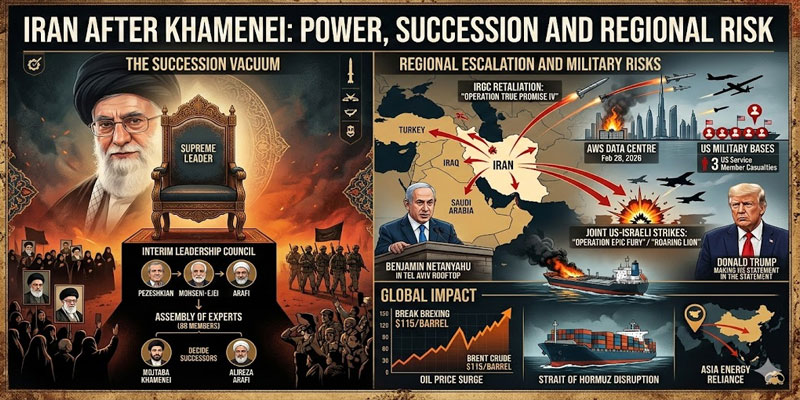
Iran has entered a new and uncertain chapter after the country’s powerful Assembly of Experts named Mojtaba Khamenei as the new Supreme Leader, succeeding his father Ayatollah Ali Khamenei, who was reportedly killed in U.S.–Israeli airstrikes on February 28 during the intensifying West Asia conflict. The announcement, confirmed by Iranian state media on March 8, marks the first clear dynastic transfer at the top of the Islamic Republic.
The appointment has dashed hopes among reformists for political change and immediately escalated geopolitical tensions. Israel has signaled that the new leader could remain a military target, while Washington under President Donald Trump has adopted a hardline stance toward Tehran. Mojtaba’s rise — backed by a vast and opaque global financial network — suggests that the regime is preparing to weather sanctions, war, and international isolation.
A Succession That Defies the Revolutionary Model
Iran’s revolutionary system was designed to avoid hereditary rule, but Mojtaba’s elevation effectively establishes a dynastic continuity. For years he operated behind the scenes, wielding influence within the Revolutionary Guards and the Basij militia, while rarely appearing in public.
His selection underscores the dominance of hardline factions determined to preserve the ideological course set by his father. Rather than moderating policy amid global pressure, the leadership transition appears to consolidate power among conservative clerical and military elites who see confrontation with the West as inevitable.
The “Empire of Shadows”
Beyond politics, Mojtaba’s influence is reinforced by a sprawling international financial network built through proxies and shell companies. Sanctioned by the United States in 2019, he is believed to control assets exceeding $138 million while indirectly benefiting from billions generated through Iranian oil sales that bypass sanctions.
Investigations have linked this network to luxury properties across several continents. Holdings reportedly include high-end mansions in London’s “Billionaire’s Row,” a Dubai villa, a former Four Seasons penthouse in Toronto, and properties in Paris. The portfolio also extends to European hospitality assets such as luxury hotels in Frankfurt, resorts in Mallorca, and ski lodges in Austria.
Much of this web operates through financial jurisdictions such as the United Kingdom, Switzerland, Liechtenstein, and the UAE, making it difficult for regulators to track or freeze funds.
Ali Ansari and the Financial Conduit
At the center of this network is sanctioned Iranian banker Ali Ansari, widely viewed as a key financial facilitator. Ansari has been associated with multiple companies including Ziba Leisure Ltd. in Saint Kitts, Birch Ventures in the Isle of Man, and UAE-based Midas Oil entities.
European investigations suggest that Ansari has amassed nearly €400 million in real estate assets and helped channel oil revenues through offshore structures. Although he denies direct ties to the Khamenei family, Western probes allege that these financial channels allowed Iranian elites to move funds despite tightening sanctions — including new restrictions imposed by the United Kingdom in October 2025.
What Mojtaba’s Leadership Means for Iran’s Nuclear Program
Perhaps the most consequential question surrounding Mojtaba’s leadership concerns Iran’s nuclear trajectory. As Supreme Leader, he holds ultimate authority over the nuclear program, including uranium enrichment and missile development.
Analysts expect continuity with — and possibly intensification of — Iran’s hardline nuclear posture. Tehran currently enriches uranium to 60% purity, close to weapons-grade levels, and possesses more than 5,500 kilograms of enriched uranium, theoretically enough to produce multiple nuclear devices if further refined.
While Ayatollah Ali Khamenei maintained a religious decree against nuclear weapons, wartime pressures and repeated strikes on facilities such as Fordow and Natanz may alter strategic calculations. Mojtaba, who has overseen elements of the Basij militia, is seen as more inclined to emphasize deterrence against U.S. and Israeli military pressure.
The result could be a shift toward maintaining rapid “breakout capability,” reducing the chances of reviving the nuclear deal framework once represented by the JCPOA.
Global and Regional Fallout
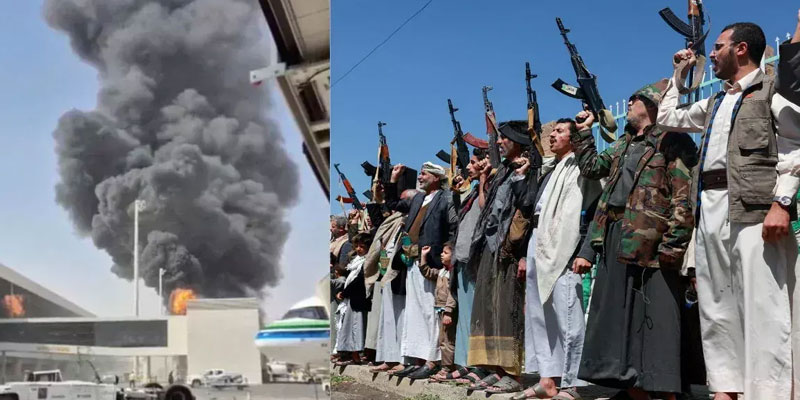
Mojtaba’s rise is likely to embolden Iran’s regional proxy network, including groups such as Hezbollah and the Houthis, intensifying confrontations across West Asia. Oil markets remain particularly sensitive, as tensions around the Strait of Hormuz threaten global supply routes.
For major energy-importing countries such as India, renewed instability could translate into higher crude prices, inflationary pressure, and disrupted supply chains.
A Hardline Era Begins
The ascent of Mojtaba Khamenei signals that Iran’s leadership transition is not a moment of reform but a consolidation of power during wartime. With a fortified financial network, strong ties to the Revolutionary Guards, and control over the nuclear program, the new Supreme Leader inherits both formidable authority and immense geopolitical pressure.
Whether this “Khamenei 2.0” era leads to deeper confrontation or cautious strategic maneuvering will shape not only Iran’s future but the stability of the entire West Asian region.
(With agency inputs)