In a carefully choreographed event in Nabarangpur, Odisha Chief Minister Mohan Charan Majhi handed over citizenship certificates to 35 minority refugees from neighbouring countries—an early, high-visibility implementation of the Citizenship (Amendment) Act (CAA). The recipients, largely Hindu migrants who arrived before the 2014 cut-off, were formally welcomed as Indian citizens in a ceremony organised with the Union Home Ministry. For Odisha, this moment was designed not merely as an administrative step but as a gesture framing CAA as an act of humanitarian inclusion rather than political polarisation.
Understanding CAA Citizenship Certificates
The CAA provides expedited citizenship to Hindu, Sikh, Christian, Buddhist, Jain and Parsi migrants from Pakistan, Bangladesh and Afghanistan who fled religious persecution and entered India before December 31, 2014. The citizenship certificates issued under the Act formalise their legal status—granting access to property rights, social welfare schemes, formal employment and political participation. Since the notification of rules in March 2024, the Centre has moved to accelerate processing through digitally driven Empowered Committees, with states playing a secondary facilitative role.
CAA’s Uneven Impact Across Border States
Assam: Identity Anxiety and NRC Shadows
In Assam, CAA implementation intersects with a long history of migration-related tensions. The state’s National Register of Citizens (NRC) exercise excluded nearly 1.9 million people, creating deep insecurity among border communities. For many Assamese nationalists, CAA appears to dilute the Assam Accord’s mandate to detect and deport all undocumented migrants irrespective of religion, raising fears of demographic pressure from Hindu Bengali settlers. Simultaneously, Muslim communities worry that CAA strengthens a ladder available only to non-Muslims, widening the gap between those who can regularise their status and those left vulnerable. The result is a dual insecurity—cultural for Assamese groups, existential for Muslims—keeping CAA at the centre of political contention.
West Bengal: Resistance and Polarisation
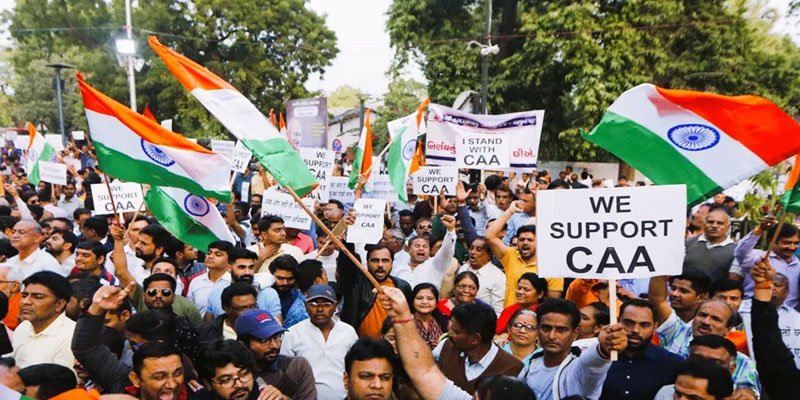
In West Bengal, Chief Minister Mamata Banerjee has turned CAA into a symbol of political defiance, arguing that it violates constitutional equality and is designed to inflame communal divisions. The state has passed resolutions opposing its rollout while assuring citizens that “CAA won’t be allowed here.” However, the Centre’s rules, which centralised processing through Union-constituted committees, limit the state’s ability to block applications entirely. The standoff has hardened political lines: CAA fuels polarisation during election cycles, while administrative cooperation remains minimal, creating a tense centre–state stalemate.
Odisha: Low Numbers, High Messaging Value
Unlike Assam or Bengal, Odisha has not faced large-scale refugee inflows from Bangladesh. Yet the state’s new BJP-led government has embraced CAA implementation as a symbolic alignment with the Centre. The Nabarangpur certificate distribution event was cast in moral, civilisational terms—portraying beneficiaries as persecuted minorities restored to dignity. Odisha’s small migrant base makes CAA here less a demographic issue and more a political and ideological statement.
A Law, Three Contexts, Divergent Politics
CAA’s rollout reveals how a single national law interacts with sharply different regional histories. Assam remains trapped between NRC anxieties and the fear of unequal citizenship outcomes; West Bengal positions CAA as a federal and ideological battleground; Odisha uses selective implementation to signal alignment and humanitarian intent. The underlying tension—legal relief available only to specific religious groups—continues to shape public sentiment. As states navigate these complexities, CAA’s future will hinge not only on administrative rules but on how deeply these regional narratives reshape the national debate.
(With agency inputs)