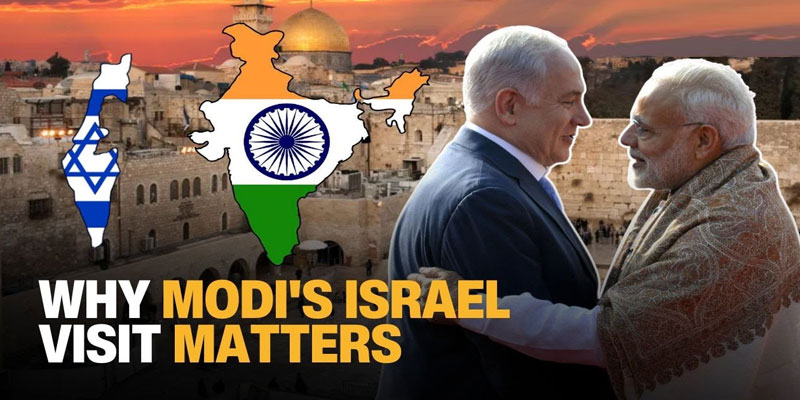
A High-Profile Visit Announced
Israeli Prime Minister Benjamin Netanyahu has announced that Prime Minister Narendra Modi will visit Israel on February 25–26, marking a significant diplomatic engagement between the two countries. The visit, Modi’s second to Israel after his landmark 2017 trip, comes at a time of evolving geopolitical dynamics in West Asia and growing India–Israel strategic convergence. Netanyahu’s remarks describing India as “enormously powerful and popular” underline the importance Israel attaches to deepening ties with New Delhi across defence, technology, and trade.
Partnership in a Changing West Asian Landscape
India–Israel relations have steadily evolved into a multifaceted strategic partnership encompassing defence cooperation, agriculture, innovation, and counter-terrorism. Since diplomatic relations were established in 1992 and elevated in the past decade, both countries have moved beyond transactional ties toward long-term collaboration. Modi’s upcoming visit is expected to reaffirm political trust while expanding economic and technological cooperation at a time when regional security challenges and global supply-chain shifts are reshaping alliances.
Key Visit Details and Symbolism
The February 2026 trip will be Modi’s first visit to Israel during his third term in office and follows the signing of a bilateral investment treaty in 2025, which provides legal protections for investors and sets the stage for deeper economic integration. The itinerary is expected to include meetings with Israeli leadership in Jerusalem and Tel Aviv, an address to the Knesset, and interactions with business and technology leaders.
The visit will likely carry symbolic weight similar to Modi’s 2017 trip, which marked a turning point in public diplomacy between the two nations. High-visibility engagements—such as innovation forums and technology showcase—are expected to reinforce cooperation in areas like agriculture technology, water management, and digital innovation.
Agenda for the Modi–Netanyahu Meeting
The bilateral talks between Modi and Netanyahu are expected to focus on three broad pillars: security cooperation, economic engagement, and regional coordination. On defence, discussions are likely to cover joint development and procurement of advanced systems, including drones, missile technology, and cybersecurity solutions. Both countries have already built strong defence trade links, and the visit could pave the way for further co-production initiatives.
Trade and investment will form another core agenda item. The recently signed bilateral investment treaty aims to boost investor confidence and could serve as a precursor to a broader free-trade framework. With bilateral trade already crossing significant thresholds, both sides are expected to explore opportunities in renewable energy, high-technology manufacturing, and digital infrastructure.
Regional security will also be high on the agenda. The leaders are expected to exchange views on the evolving situation in West Asia, maritime security, and multilateral initiatives such as the India–Middle East–Europe corridor. Cooperation within frameworks like the I2U2 grouping is likely to be reviewed, particularly in areas of food security, energy, and technology.
Strategic Convergence with Global Implications
Modi’s upcoming visit to Israel reflects the maturation of a relationship that now spans strategic, economic, and technological domains. As both countries navigate complex regional and global challenges, the partnership offers mutual benefits—India gains access to advanced technologies and defence capabilities, while Israel strengthens ties with a major emerging power. If the visit delivers concrete outcomes on investment, co-production, and innovation, it could further institutionalise a partnership that has become a key pillar of India’s West Asia policy and Israel’s outreach to Asia.
(With agency inputs)