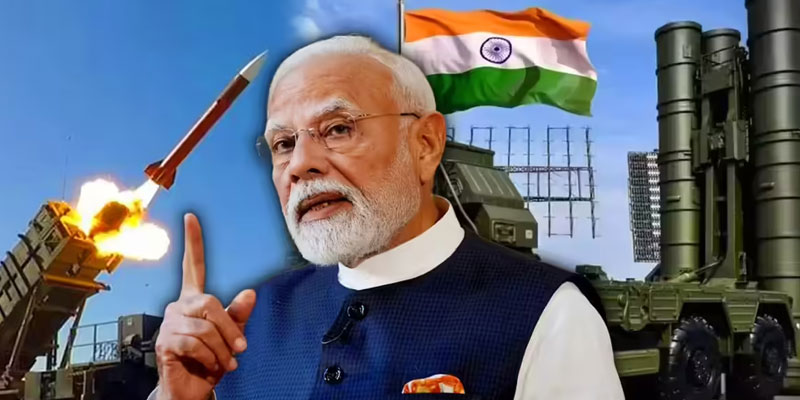
India’s defence establishment has cleared a major replenishment of its advanced air-defence inventory following operational use during Operation Sindoor. The Defence Acquisition Council, chaired by Rajnath Singh, has endorsed procurement of 288 additional S-400 missiles from Russia under an expedited process. The decision comes after the system’s reported employment in the Sindoor operation, where it played a decisive role in intercepting aerial threats and reinforcing India’s layered air-defence network.
The new acquisition includes both short- and long-range interceptor variants and is intended to restore stocks and sustain readiness amid a volatile regional security environment.
Procurement Rationale and Tri-Service Upgrades
The latest approval forms part of a wider push to accelerate military modernization across all three services. For the Indian Air Force, replenishing S-400 missile inventories is seen as essential to maintaining credible air-denial capability along sensitive frontiers. There are also indications of plans for additional squadrons and complementary systems to create a multi-tier shield against aircraft, cruise missiles, and emerging drone threats.
Parallel initiatives have been cleared for the Army and Navy. The Army will receive upgraded armoured platforms, recovery vehicles, and anti-tank mine systems to enhance mobility and survivability across high-altitude and desert theatres. Meanwhile, the Navy is set to acquire indigenous marine power-generation technology and additional long-range maritime reconnaissance aircraft, strengthening surveillance and anti-submarine warfare capacity across the Indian Ocean Region.
Taken together, these measures underscore India’s attempt to balance rapid procurement of proven systems with longer-term indigenous capability building.
Strategic Impact on India–Pakistan Air Defence Balance
The replenishment of S-400 missile stocks has significant implications for the regional air-defence equilibrium, particularly vis-à-vis Pakistan. The S-400’s extended detection and engagement ranges allow India to establish layered defensive “bubbles” capable of tracking multiple targets simultaneously, including aircraft, drones, and ballistic or cruise missiles. This significantly complicates adversary air operations near the border.
For Pakistan’s air force, the presence of S-400 batteries along key sectors compresses operational space and forces greater reliance on low-altitude or stand-off tactics. While Islamabad fields its own Chinese-origin air-defence systems, their range and tracking capacity remain more limited compared to the S-400’s advertised capabilities. This asymmetry could tilt the balance toward India in terms of early warning, interception depth, and protection of strategic assets.
However, the equation is not static. Pakistan may respond by investing in suppression-of-enemy-air-
Operational and Geopolitical Considerations
Beyond the immediate India–Pakistan context, the acquisition highlights India’s continued reliance on Russian military technology even as it diversifies suppliers. Expedited procurement signals urgency in filling capability gaps, though it also raises questions about delivery timelines and supply-chain resilience amid global geopolitical tensions.
At the same time, integrating imported systems with indigenous platforms remains central to India’s long-term strategy of self-reliance in defence production.
Reinforcing Deterrence in a Fluid Security Landscape
The decision to replenish S-400 missile stocks reflects both operational lessons from recent deployments and broader concerns about regional stability. By strengthening its layered air-defence architecture, India aims to secure strategic assets and deter aerial incursions. Yet the move also reshapes the subcontinental military balance, prompting adjustments in Pakistan’s air strategy. Ultimately, the S-400 expansion reinforces India’s defensive posture while underscoring the evolving technological contest that defines modern South Asian security dynamics.
(With agency inputs)