A Long-Delayed Reset of India’s Demographic Baseline
India has formally set 2027 as the year for its next national Census, approving an expenditure of roughly ₹11,718 crore for what will be the country’s first fully digital enumeration. The decision closes a prolonged gap caused by the Covid-19 pandemic, which forced the postponement of an exercise originally due in 2021. More than a routine statistical update, Census 2027 signals a technological, administrative, and political shift in how the Indian state counts—and understands—its population.
Census in India: Why It Matters
Since 1881, India’s Census has served as the backbone of governance, shaping everything from parliamentary constituencies and fiscal transfers to welfare design and urban planning. Conducted every ten years under the Census Act of 1948, it provides the most authoritative snapshot of population size, composition, housing conditions, migration, language, religion, and livelihoods. With the last Census conducted in 2011, policymakers are now operating with demographic data that is more than a decade old—an increasingly serious handicap in a rapidly urbanising and mobile society.
How Census 2027 Will Be Conducted
The 2027 Census will follow a two-phase structure. The first phase—house listing and housing census—will be carried out over a 30-day window chosen by individual states and Union Territories between April and September 2026. The second phase, population enumeration, is scheduled for February 2027, with March 1, 2027 set as the reference date for most of the country. Snow-bound and remote regions will follow an earlier timeline, continuing a long-standing practice to accommodate terrain and climate.
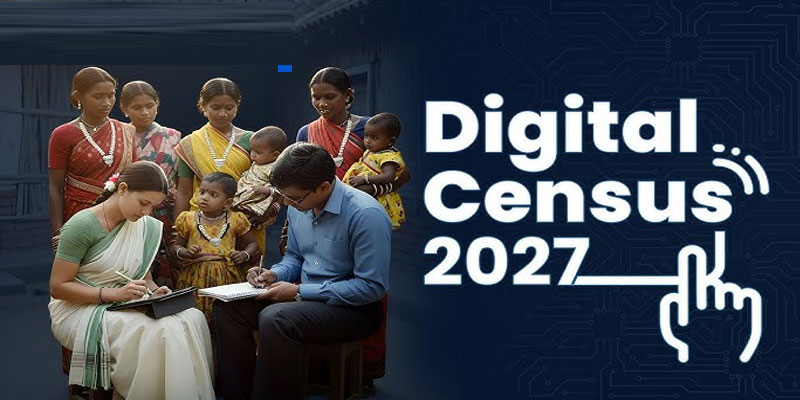
Operationally, the scale remains immense: nearly 30 lakh enumerators will be deployed. The key departure from past exercises is digitisation. Enumerators will use handheld devices, while households will have the option of self-enumeration through an online portal. The government argues this will reduce errors, speed up data processing, and allow faster publication of results.
The Digital Turn: Efficiency Meets Privacy Risk
While digitisation promises administrative gains, it also introduces significant data privacy concerns. A fully digital Census entails centralised storage of highly sensitive information—caste, religion, income proxies, migration status—creating an attractive target for cyberattacks. Past breaches involving government platforms have heightened public scepticism about data security.
Self-enumeration adds another layer of vulnerability. Data entered on personal devices and transmitted over unsecured networks could be exposed during transmission if encryption and authentication standards are unevenly implemented. Concerns also persist about potential linkage with other large databases such as Aadhaar or welfare registries, raising fears of profiling or surveillance.
India’s Digital Personal Data Protection Act, 2023 provides a legal framework, but enforcement mechanisms remain untested at this scale. In a politically polarised environment, even the perception that census data could be misused risks eroding public trust in a process that relies on mandatory participation and honest disclosure.
Safeguards and the Trust Deficit
The government has indicated that encryption, anonymisation, and strict access controls will be built into census systems, with legal prohibitions on sharing identifiable data. Independent audits, transparency around data use, and clear separation from law-enforcement or commercial databases will be crucial. Equally important will be bridging the digital divide, ensuring that digitisation does not translate into exclusion or coerced disclosure.
Counting People, Protecting Confidence
Census 2027 is more than a statistical exercise—it is a test of state capacity in the digital age. If executed with transparency and robust safeguards, it can restore India’s demographic baseline and strengthen evidence-based policymaking. If privacy concerns are mishandled, however, efficiency gains may come at the cost of public confidence. In a democracy of 1.4 billion people, how the state counts its citizens is inseparable from how it earns their trust.
(With agency inputs)