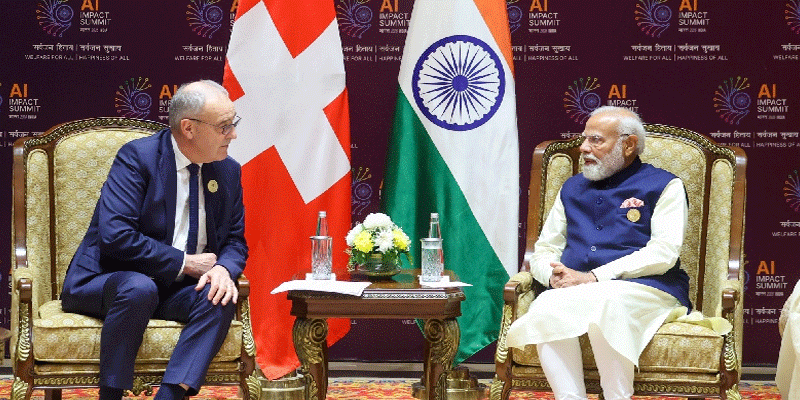
PM Modi wants BRICS to help 100 startups scale yearly, signalling a shift from broad diplomatic commitments towards measurable economic cooperation. The proposal, made at the BRICS Business Forum in New Delhi, also seeks to identify the top 10 trade barriers and facilitate 1,000 new business partnerships annually.
From Political Grouping to Economic Platform
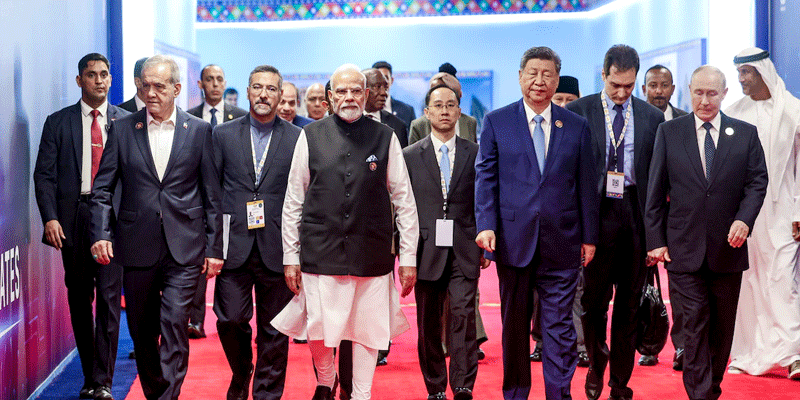
The 18th BRICS Summit, held in New Delhi on September 12–13, 2026, under India’s chairship, focused on “Building for Resilience, Innovation, Cooperation and Sustainability”. Since its formation by Brazil, Russia, India and China in 2009, BRICS has expanded significantly, with South Africa joining in 2010 and further enlargement beginning in 2024. It now comprises 11 members—Brazil, Russia, India, China, South Africa, Egypt, Ethiopia, Iran, the UAE, Indonesia and Saudi Arabia.
This expansion has increased BRICS’ economic and political weight, but also created greater challenges for consensus and implementation. The 140-point New Delhi Declaration therefore attempts to translate the grouping’s three pillars—political-security, economic-financial, and cultural cooperation—into more actionable areas.
BRICS Startup Push Gains Policy Backing
The startup agenda stands out as one of the declaration’s most practical economic initiatives. Leaders welcomed the creation of a BRICS Incubator Network, connecting startup incubators and national nodal agencies across member countries. The network is intended to provide mentorship, investor access and assistance in overcoming market-entry challenges.
The declaration also supported further consideration of a BRICS Startup Innovation Fund, which could mobilise voluntary public and private capital to address financing gaps across different stages of startup development. A virtual BRICS Youth Startup Platform, along with stronger cooperation through the BRICS Startup Knowledge Hub and Startup Forum, adds an ecosystem-building dimension.
Against this backdrop, Modi’s proposal for 100 startups from each member country to expand into fellow BRICS markets could provide a clear annual performance benchmark. Rather than merely encouraging entrepreneurship, it seeks to create actual cross-border business opportunities.
Removing Barriers Will Determine Success
However, funding and incubation alone cannot make the initiative work. Startups entering foreign BRICS markets must navigate different taxation structures, regulations, data-governance rules, intellectual-property protections, languages and payment systems. Modi’s proposal to identify the top 10 trade barriers is therefore critical.
The wider technology agenda strengthens this objective. BRICS has backed cooperation on digital public infrastructure, artificial intelligence and interoperable cross-border payments. Collaboration in these areas could lower transaction costs and allow emerging economies to share solutions in governance, finance, healthcare and education. Support for MSME financing, manufacturing, logistics, industrial parks and technology transfer could further connect startups with established industrial ecosystems.
Execution Must Match Ambition
The real test will be implementation. A voluntary innovation fund needs transparent governance, credible selection mechanisms and meaningful private-sector participation. Similarly, an incubator network will matter only if startups receive regulatory guidance, procurement opportunities, investor access and real customers.
If these mechanisms deliver measurable outcomes, India’s proposal could give BRICS a more practical economic identity—linking entrepreneurship, technology, trade and South-South cooperation. The success of the startup push will ultimately depend not on how many initiatives BRICS announces, but on how many businesses it actually helps cross borders and scale.
(With agency inputs)