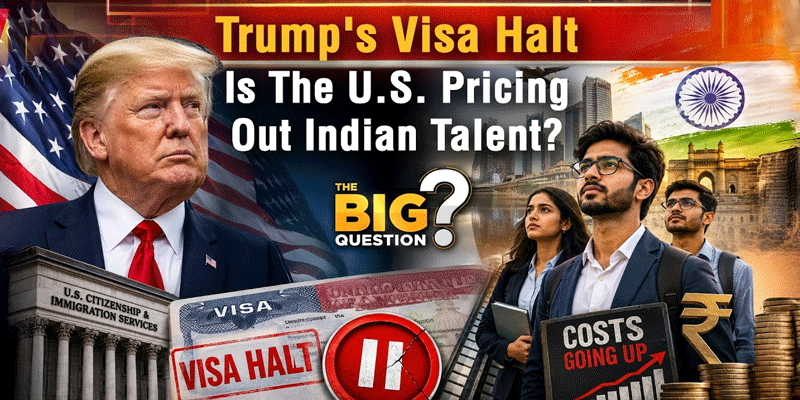
Donald Trump’s recent remarks—labeling countries like India and China as “hellholes” while attacking birthright citizenship—have reignited controversy, raising questions about misinformation, diplomacy, and the future of U.S. immigration policy.
A Controversial Statement Goes Global
U.S. President Donald Trump has once again stirred international debate after reposting a provocative message on Truth Social. The post amplified comments by radio host Michael Savage, who described countries such as India and China in derogatory terms while accusing immigrants of exploiting U.S. citizenship laws. The remarks have drawn sharp criticism not only for their tone but also for their broader political implications.
Amplifying Fringe Narratives
The controversy stems from Trump resharing excerpts of Savage’s podcast, where inflammatory claims were made about immigrants from India, China, and other nations. The rhetoric alleged that wealthy individuals travel to the United States late in pregnancy to secure citizenship for their children—a practice often referred to as “birth tourism.”
By reposting this content, Trump effectively elevated a fringe narrative into mainstream political discourse. Critics argue that such amplification blurs the line between personal opinion and political endorsement, particularly when shared on a platform closely associated with a former head of state.
The Birthright Citizenship Debate
At the center of this controversy is the long-standing issue of birthright citizenship in the United States. Trump has argued that the U.S. is unique in granting automatic citizenship to anyone born on its soil, a claim he recently repeated in an interview with CNBC.
However, comparative legal data contradicts this assertion. Dozens of countries—including Canada and Mexico—also follow similar principles. This undermines the argument that the U.S. system is an outlier requiring urgent reform.
Trump’s push to end birthright citizenship is expected to face significant legal challenges, potentially culminating in a decisive ruling by the Supreme Court of the United States. The issue sits at the intersection of constitutional interpretation and political ideology, making it one of the most contentious policy debates in recent years.
Diplomatic Fallout and Domestic Reaction
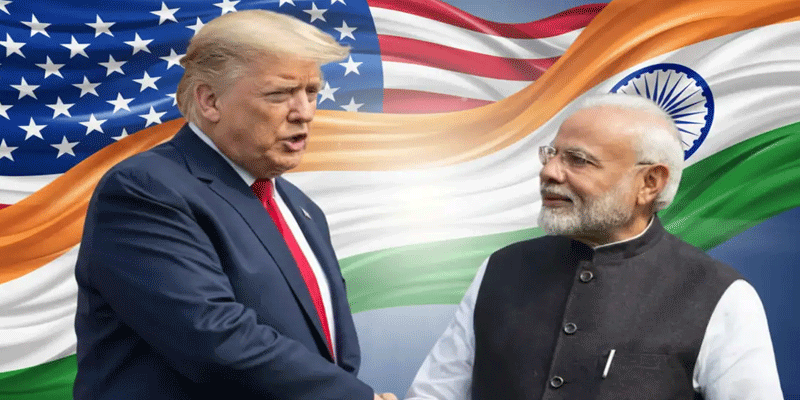
The use of derogatory language for major global economies like India and China has triggered diplomatic unease. Both countries are key strategic and economic partners of the United States, and such rhetoric risks straining already complex relationships.
Domestically, the backlash has been equally strong. Immigration advocates and legal scholars have criticized the remarks as xenophobic and misleading. They argue that framing immigration debates through racially charged narratives diverts attention from substantive policy discussions and fuels social division.
At the same time, Trump’s statements resonate with a segment of voters who support stricter immigration controls, highlighting the deeply polarized nature of the issue in American politics.
A Broader Political Strategy?
Analysts suggest that the timing and tone of these remarks may be part of a broader political strategy aimed at mobilizing a nationalist voter base. By combining strong rhetoric with policy proposals, Trump continues to position immigration as a central campaign issue.
However, this approach also raises concerns about the global perception of U.S. leadership. The blending of inflammatory language with policy advocacy risks undermining the credibility of American institutions on issues of equality and human rights.
Words, Policy, and Consequences
Trump’s latest remarks underscore how language and policy are increasingly intertwined in modern politics. While debates over birthright citizenship are legitimate and complex, their framing matters profoundly. As the issue moves toward potential judicial review, the challenge for policymakers will be to separate fact from rhetoric and ensure that decisions are guided by constitutional principles rather than divisive narratives.
(With agency inputs)