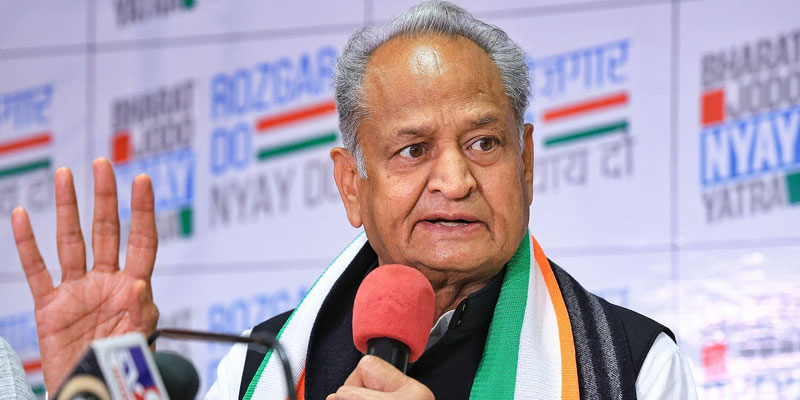
Senior Congress leader Ashok Gehlot triggered a major political controversy after claiming that former Prime Minister Indira Gandhi would have banned the Bharatiya Janata Party (BJP) if she were alive today. Speaking at an award function in Jaipur, Gehlot accused the BJP of encouraging religious polarisation and creating what he described as the “most troubling phase” of public life he had witnessed in five decades of politics. The BJP responded sharply, accusing the Congress of carrying an authoritarian mindset rooted in the Emergency era and attacking Hindutva ideology.
What Gehlot Said and Why It Sparked Debate
Gehlot’s remarks centred on the BJP’s political approach and its handling of minority representation. He questioned why the BJP rarely fields Muslim candidates in elections, particularly in states such as Uttar Pradesh, arguing that even symbolic representation could promote inclusivity and social harmony.
According to Gehlot, the political atmosphere in the country has become increasingly divisive because of religion-based mobilisation. He argued that Indira Gandhi, known for taking strong political decisions during her tenure, would not have tolerated such a climate and might have considered banning the BJP.
The statement immediately escalated into a national political flashpoint because it invoked both religious politics and the legacy of the Emergency imposed by Indira Gandhi in 1975.
Congress, BJP And the Emergency Legacy
The Congress and BJP have long been engaged in ideological battles over secularism, nationalism, and the role of religion in politics. The BJP frequently accuses the Congress of practising minority appeasement, while the Congress accuses the BJP of promoting majoritarian politics under the broader umbrella of Hindutva.
The controversy also revived memories of the Emergency period, during which civil liberties were suspended, opposition leaders jailed, and democratic institutions heavily restricted under Indira Gandhi’s government. The BJP and its ideological predecessors often cite the Emergency as evidence of Congress’s authoritarian tendencies.
Gehlot’s remarks therefore touched a particularly sensitive historical and political nerve.
BJP’s Sharp Counterattack
The BJP launched an aggressive response soon after the comments surfaced publicly.
BJP spokesperson Shehzad Poonawalla described the statement as provocative and accused the Congress of displaying hostility toward Hindus and Hindutva. He alleged that the Congress attempts to divide communities for electoral purposes while portraying itself as secular.
Union Minister Kiren Rijiju also criticised Gehlot, arguing that the comments reflected the same “dictatorial mindset” associated with the Emergency era. Rijiju warned against what he termed dynastic and authoritarian tendencies within the Congress party.
The BJP additionally defended Hindutva as a cultural and civilisational concept, citing past judicial observations describing it as a “way of life” rather than merely a political ideology.
Larger Ideological Clash Behind the Controversy
Beyond the immediate exchange of accusations, the episode reflects a much deeper ideological confrontation shaping Indian politics today. Questions around minority representation, religious identity, secularism, and nationalism continue to dominate political discourse ahead of future elections.
For the Congress, the issue revolves around inclusivity and democratic pluralism. For the BJP, the debate is framed around cultural identity and opposition to what it calls selective secularism.
Political Rhetoric Revives Historical Fault Lines
Ashok Gehlot’s comments have reignited one of India’s oldest political fault lines — the debate between secularism and Hindutva, democracy and centralised authority. While the controversy may remain part of routine political rhetoric, it also reveals how historical memories such as the Emergency continue to shape contemporary political narratives. As both parties sharpen ideological positions, such confrontations are likely to intensify in the run-up to future electoral battles.
(With agency inputs)