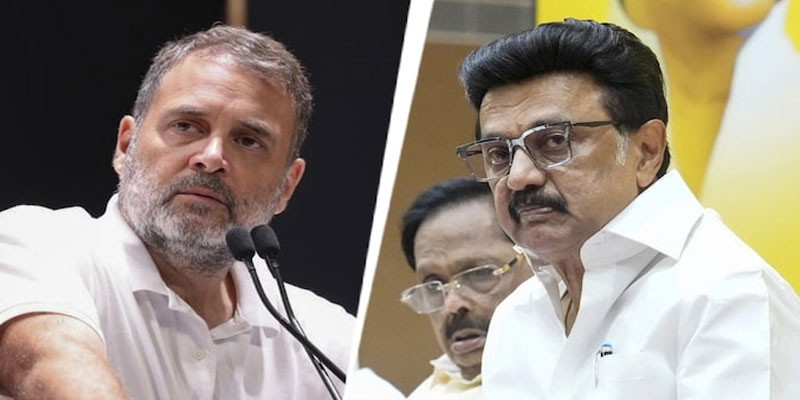
The DMK has accused the Congress of undermining INDIA bloc allies in state elections while later seeking their support during Lok Sabha polls. The party has also alleged that Congress, with Rahul Gandhi’s backing, “backstabbed” the DMK during the Tamil Nadu Assembly elections, leading to the collapse of a political partnership that had endured for nearly two decades. The sharp criticism marks one of the most public and direct confrontations within the opposition camp and has reignited debate over the future cohesion of the INDIA bloc.
A Longstanding Alliance Under Strain
The DMK and Congress have shared a close political relationship for years, particularly in Tamil Nadu, where the two parties often fought elections together against common rivals. However, the alliance came under severe strain following the recent Tamil Nadu Assembly elections, after Congress chose to align itself with Vijay’s Tamilaga Vetri Kazhagam (TVK), effectively ending its long-standing association with the DMK.
The latest criticism was articulated through Murasoli, the DMK’s official publication, which accused Congress of employing tactics that weakened its allies in state-level contests while expecting their support during national elections. According to the DMK, such actions have raised questions about Congress’s reliability as a coalition partner.
The Rahul Gandhi Factor
A significant portion of the DMK’s criticism has been directed at Congress leader Rahul Gandhi. The party claimed that decisions leading to the alliance rupture were taken with his approval and described his recent calls for opposition unity as a delayed realization of the challenges facing the alliance.
The criticism gained momentum after remarks attributed to Rahul Gandhi regarding Left parties sparked reactions from leaders across the opposition spectrum. Communist Party of India (CPI) leaders reportedly described some of his observations as politically immature, while other opposition figures questioned the timing and tone of his statements.
For the DMK, these developments have reinforced concerns that Congress’s political approach has often alienated allies rather than strengthened collective opposition efforts.
Growing Unease Within the INDIA Bloc
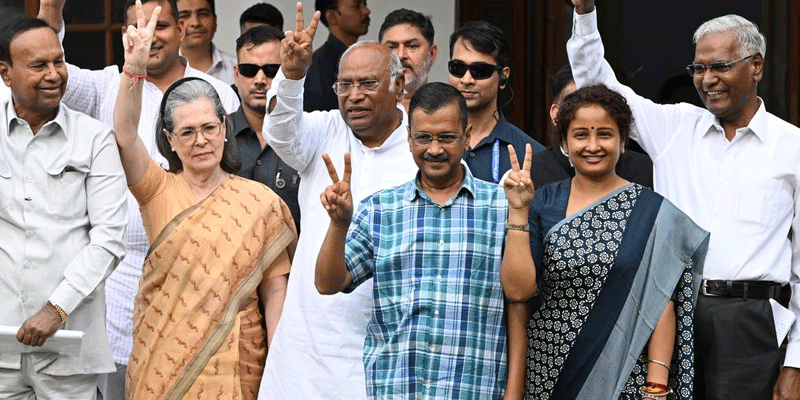
The controversy extends beyond the DMK-Congress relationship. Several opposition leaders have reportedly expressed dissatisfaction with the way Congress has managed its alliances and political messaging.
Concerns have emerged over whether the bloc’s constituent parties are adequately consulted on major political decisions. Some leaders have warned that continued disagreements could weaken the alliance’s ability to present a united challenge to the BJP-led National Democratic Alliance (NDA).
The DMK has highlighted these concerns to argue that the issue is not merely a bilateral dispute but a broader challenge confronting the opposition coalition.
Political Implications for Congress and the Opposition
The fallout has significant implications for both Congress and the INDIA bloc. For Congress, the criticism risks creating doubts among regional parties about its dependability as an alliance partner. Regional parties increasingly play a decisive role in state-level politics, making trust and coordination crucial for any national coalition.
For the opposition alliance, the dispute exposes underlying tensions that could complicate future electoral strategies. Maintaining unity across diverse regional and ideological interests remains one of the bloc’s biggest challenges.
A Test of Opposition Cohesion
The DMK’s sharp attack on Congress underscores the fragile nature of opposition politics in India. While differences among alliance partners are not uncommon, public exchanges of this intensity reveal deeper concerns about leadership, coordination and trust. As political parties prepare for future electoral battles, the ability of the INDIA bloc to address these divisions and rebuild confidence among its partners may prove critical to its long-term viability and effectiveness.
(With agency inputs)