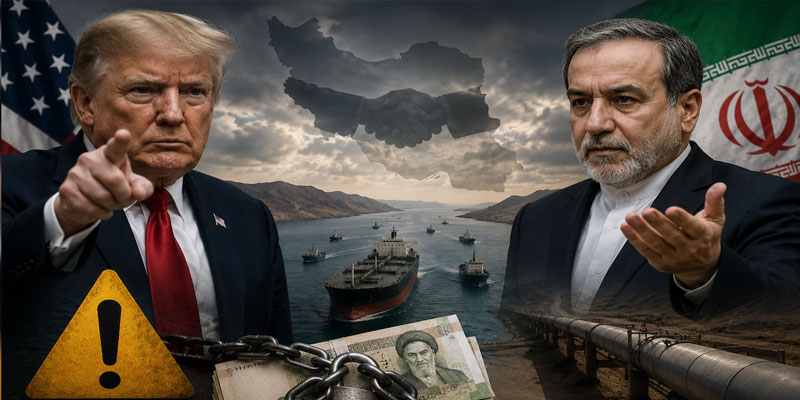
President Donald Trump’s assertion that the United States has “no obligation” to invest in Iran even after a potential agreement to end the ongoing Middle East conflict has added a new dimension to already delicate negotiations between Washington and Tehran. While the proposed memorandum of understanding (MoU) is aimed at reducing tensions and creating a framework for future engagement, Trump’s remarks underline that any peace arrangement may stop short of guaranteeing economic assistance. The statement reflects a broader strategy of maintaining leverage while pursuing diplomatic de-escalation.
A Conflict Seeking a Diplomatic Exit
The proposed agreement comes after months of heightened tensions involving military operations, maritime security concerns and regional proxy confrontations. Both sides have faced growing international pressure to avoid further escalation and seek a diplomatic pathway toward stability.
For Iran, negotiations represent an opportunity to secure relief from economic constraints, regain access to frozen assets and protect key elements of its strategic infrastructure. For the United States, the priority appears to be preventing a wider regional conflict while ensuring that Iran’s future actions remain subject to international scrutiny.
The emerging framework is therefore less a final settlement and more an attempt to create conditions for sustained dialogue.
Trump’s Economic Stance
At the center of the latest debate is Trump’s declaration that the United States is under no obligation to fund Iran’s reconstruction or economic recovery. While leaving open the possibility of future investment if it serves American interests, he made clear that no automatic financial commitment would accompany a peace agreement.
The position is significant because reports surrounding the draft framework had suggested discussions about large-scale reconstruction proposals involving international partners. By distancing Washington from any guaranteed funding package, Trump has emphasized a transactional approach that prioritizes strategic flexibility over long-term economic commitments.
The message also reinforces the administration’s belief that normalization of relations should not automatically translate into financial support.
The Hormuz Question and Strategic Interests
Another important aspect of the proposed agreement concerns the Strait of Hormuz, one of the world’s most critical energy transit routes. Discussions have focused on ensuring uninterrupted shipping through the corridor and reducing risks to global energy markets.
However, differing interpretations remain. While the United States has highlighted the prospect of unrestricted maritime movement under the agreement, Iranian officials have suggested that operational arrangements would remain subject to Tehran’s authority. These contrasting positions illustrate the challenges that negotiators still face in translating broad principles into workable policies.
The Unresolved Nuclear Issue
Perhaps the most consequential aspect of the proposed understanding is what it does not resolve. Rather than directly settling disputes over Iran’s nuclear programme, the framework reportedly postpones those discussions to a later negotiation phase.
This approach effectively preserves the current status quo while creating a limited window for future talks on uranium stockpiles, sanctions relief and the scope of Iran’s civilian nuclear activities. Supporters view this as a pragmatic way to reduce immediate tensions, while critics argue that delaying core issues merely postpones future confrontations.
A Fragile Peace with Critical Questions Ahead
Trump’s refusal to commit American investment highlights the cautious and conditional nature of the emerging agreement. While the proposed framework may help reduce immediate tensions and create momentum for diplomacy, major issues—including nuclear activities, sanctions and regional security—remain unresolved. The success of the initiative will ultimately depend on whether both sides can use the coming negotiations to build trust and address these deeper structural challenges. Until then, any peace achieved is likely to remain fragile, shaped as much by unresolved differences as by diplomatic progress.
(With agency inputs)