EY’s Economy Watch: A Promising Outlook
The August edition of EY’s Economy Watch Report paints an ambitious yet credible future for India. According to the global consultancy, the country could climb to the position of the world’s second-largest economy by 2038, measured in purchasing power parity (PPP) terms, with an estimated GDP of $34.2 trillion. Importantly, this ascent is not driven by population strength alone; it is being underpinned by policy reforms, structural adjustments, and resilient macroeconomic fundamentals.
In the nearer term, EY projects India’s economy could hit $20.7 trillion (PPP) by 2030, marking a significant leap that underscores its momentum amid global uncertainties.
Why India Stands Out
What differentiates India from many of its economic peers is a unique combination of youthful demographics, robust savings and investment rates, and a fiscal outlook that appears sustainable in the medium term. By 2025, India’s median age is projected at just 28.8 years—one of the youngest among major economies. This translates to a more productive workforce, growing consumption, and innovation-led growth.
At the same time, India’s gross savings rate remains among the highest in the world, while its debt-to-GDP ratio is forecast to decline from 81.3% in 2024 to 75.8% by 2030. This trend contrasts sharply with advanced economies such as the United States, where government debt is expected to climb above 120% of GDP, or Japan and Germany, where fiscal constraints are tightening amid aging populations.
Global Comparisons and Shifting Dynamics
The report highlights that while China will likely retain its top spot by 2030 at $42.2 trillion (PPP), it faces headwinds in the form of demographic decline and surging debt. Similarly, the U.S. economy, though resilient, is battling high debt burdens and a slowing growth trajectory. Japan and Germany, both advanced industrial powers, are constrained by rapidly greying populations and heavy reliance on international trade—factors that leave them vulnerable to external shocks.
In contrast, India’s demand-driven growth model and youthful workforce provide a degree of insulation from global downturns, making it a rare bright spot amid broader uncertainty.
The Reform Dividend
EY underscores that India’s progress owes much to structural reforms carried out over the past decade. The implementation of the Goods and Services Tax (GST) has streamlined indirect taxation, while the Insolvency and Bankruptcy Code (IBC) has enhanced credit discipline and improved the business environment. The rise of digital finance through platforms such as the Unified Payments Interface (UPI) has deepened financial inclusion, bringing millions into the formal economy.
Meanwhile, the Production-Linked Incentive (PLI) schemes are fostering domestic manufacturing across electronics, renewable energy, and pharmaceuticals, strengthening India’s industrial base and reducing dependence on imports. These reforms, taken together, create an enabling ecosystem for sustainable growth.
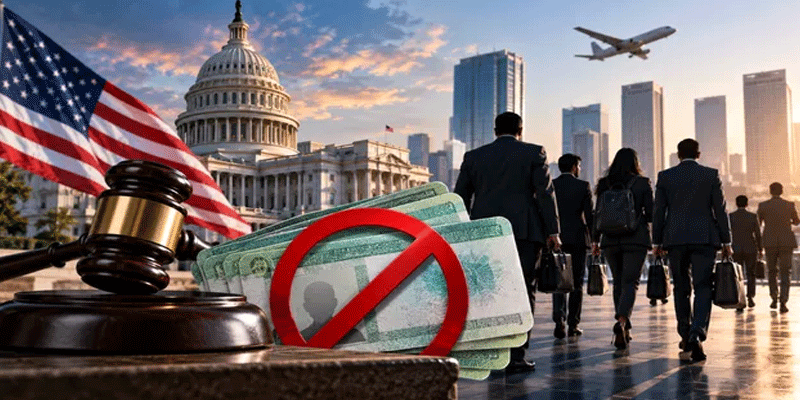
The report also evaluates risks. For instance, U.S. tariffs could shave off as much as 0.9% of India’s GDP. However, EY notes that with timely countermeasures—ranging from diversifying export destinations to boosting domestic demand and cultivating fresh trade partnerships—the impact could be limited to just 0.1 percentage point on GDP growth.
This resilience underscores India’s growing confidence in navigating global turbulence while keeping its long-term trajectory intact.
A Constructive Road Ahead
India’s story is no longer one of potential—it is fast becoming a narrative of execution. A young population, prudent fiscal management, and strategic reforms are providing the foundations for sustained expansion. Unlike peers wrestling with debt or aging populations, India has positioned itself as a growth engine not only for Asia but for the world.
Beyond sheer numbers, India’s rise is reflected in multiple sectors: it is a global hub for digital payments, an emerging leader in renewable energy, and a strong player in pharmaceuticals and space technology. Its expanding middle class is driving consumption, while its innovation ecosystem is fueling entrepreneurship.
As EY’s report suggests, the road to becoming the world’s second-largest economy will not be free of hurdles. Yet, with resilience, reform, and renewal at its core, India is charting a path that blends demographic advantage with structural strength—an ascent that could reshape the global economic order by 2038.
(With agency inputs)