A Quiet Revision with Loud Implications
The United States has revised its official factsheet on the evolving trade arrangement with India, removing references to tariff reductions on pulses — a sensitive agricultural category for New Delhi. The adjustment came shortly after the White House initially suggested India would lower duties on items such as lentils and chickpeas. Within a day, those references vanished, replaced by broader language about a “wide range” of agricultural products. The swift change underscores how carefully calibrated the ongoing US-India trade negotiations remain, particularly on politically charged farm commodities.
Trade Diplomacy Meets Domestic Pressures
The revision illustrates the delicate balance shaping Washington–New Delhi economic engagement under a more assertive US trade posture. While both sides have publicly framed their discussions as a step toward deeper commercial ties, the fine print reveals unresolved tensions. Agriculture — especially pulses — has emerged as a symbolic and substantive fault line, reflecting India’s domestic priorities and the United States’ push for reciprocal market access.
What the February 6 Joint Statement Said
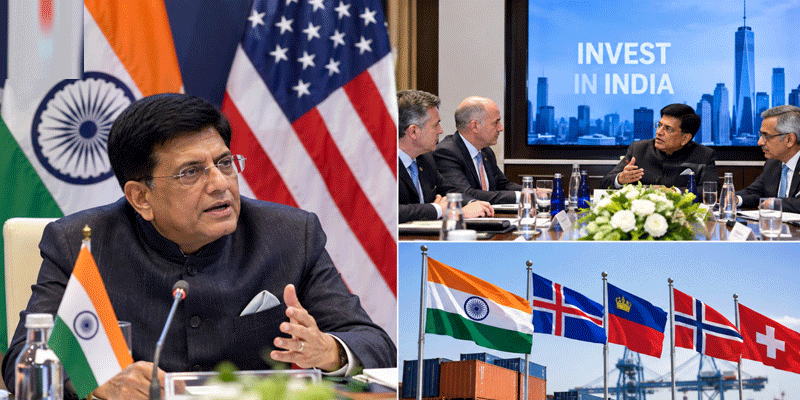
A joint statement issued on February 6 following discussions between US President Donald Trump and Indian Prime Minister Narendra Modi outlined an interim framework for closer trade cooperation. It emphasized expanded market access, reduction of certain tariffs on industrial goods, and India’s stated intention to increase purchases of US energy, technology, and other products over time. Notably, the statement avoided listing specific agricultural concessions.
The document also highlighted efforts to reduce non-tariff barriers, streamline import licensing for US medical devices, and improve regulatory conditions for bilateral trade. On digital commerce, both sides committed to fair taxation principles without explicitly pledging to eliminate India’s digital services tax. The leaders described the framework as a stepping stone toward a comprehensive bilateral trade agreement by 2027, while also reinforcing cooperation through technology initiatives and supply-chain partnerships.
Why Pulses Became a Flashpoint
The controversy arose when a subsequent US factsheet appeared to specify tariff cuts on pulses, sorghum, and other agricultural items — language absent from the joint statement. Indian officials reportedly objected, viewing pulses as a domestic red line due to their role in food security and farmer livelihoods. India produces tens of millions of tonnes of pulses annually and maintains steep import duties to shield growers from global price swings and subsidized foreign produce.
Political considerations amplify the sensitivity. Farmer groups remain influential, and any perception of concessions to foreign agricultural imports risks domestic backlash. By removing explicit mentions of pulses, Washington signaled a willingness to recalibrate its messaging to preserve broader negotiations.
Broader Strategic Context
Despite friction over agriculture, both governments continue to pursue deeper trade ties. The framework envisions expanded US exports to India in energy, technology, and manufacturing, alongside potential tariff reductions on industrial goods. For Washington, closer economic alignment with India supports strategic goals in Asia. For New Delhi, maintaining policy space in agriculture while securing technology and investment flows remains paramount.
Realignment Rather Than Retreat
The revised factsheet does not indicate a breakdown in talks but rather a recalibration reflecting mutual constraints. The February 6 framework remains intentionally broad, allowing negotiators to advance cooperation without triggering domestic opposition. The removal of pulse-related language highlights India’s negotiating leverage and the political limits of rapid liberalization. Ultimately, the episode illustrates a pragmatic partnership: both sides appear willing to adjust tactics to sustain momentum toward a more comprehensive trade agreement while managing the sensitivities that accompany it.
(With agency inputs)