From Academic Allies to Policy Adversaries
For years, education served as the golden bridge connecting India and Canada—an enduring symbol of trust, collaboration, and opportunity. Canada’s welcoming stance toward international learners, coupled with its world-class universities and clear immigration pathways, made it a preferred destination for Indian students. By 2023, Indians accounted for an astonishing 41% of all international study permit holders, turning education into a cornerstone of bilateral engagement. This exchange not only strengthened cultural and professional bonds but also injected billions into Canada’s economy. Yet, since late 2023, this flourishing partnership has faced unprecedented strain—threatening to redefine one of the most successful people-to-people linkages between the two nations.
The Policy Shift: From Open Doors to Tight Controls
In 2024, Canada drastically recalibrated its international student policy amid housing shortages, visa fraud concerns, and pressure on public services. A new cap cut study permits by 35%, followed in 2025 by a further reduction to 437,000—10% below the previous year. For the first time, even postgraduate applicants fell under this quota. Added hurdles like Provincial Attestation Letters, higher proof-of-funds, and stricter compliance rules have made the process tougher. Ontario and British Columbia, key hubs for Indian students, saw the steepest declines, leaving many applicants frustrated by an increasingly opaque system.
Immediate Fallout: Sharp Decline in Indian Student Approvals
The consequences have been swift and severe. Between January and June 2025, approval rates for Indian students plummeted between 31% and 65% year-on-year. In some quarters, rejection rates soared to nearly 80%—the highest ever recorded for Indian applicants. The data from August 2025 paints a stark picture: only 4,515 Indian students were granted study permits, compared to nearly 21,000 in August 2023.
Universities such as Waterloo, Saskatchewan, and Windsor reported declines of over two-thirds in India-origin enrollments. Officials attribute this partly to heightened vigilance following revelations of fraudulent admission letters and cases where students allegedly used education as a pathway to permanent residency rather than academic pursuit. The narrative has shifted from mutual trust to mutual suspicion—deeply affecting the reputation of legitimate students and institutions alike.
Diplomatic Undercurrents: A Relationship Under Strain
This tightening of visa policy cannot be viewed in isolation. It unfolds against a backdrop of deteriorating diplomatic relations. In 2023, Prime Minister Justin Trudeau’s controversial allegation of India’s involvement in the killing of a Canadian citizen triggered a sharp diplomatic standoff. Both nations expelled diplomats and froze several cooperative dialogues, creating an atmosphere of mistrust that inevitably spilled into the education sector.
Canada’s clampdown, while officially driven by domestic policy concerns, also reflects this strained political environment. Indian students—once considered valuable contributors to Canada’s social and economic fabric—now find themselves caught in the crossfire of geopolitical tension and bureaucratic caution. The result is a chilling effect on mobility, collaboration, and the broader goodwill that once characterized bilateral engagement.
Signs of Reconciliation: Can the Bridge Be Rebuilt?
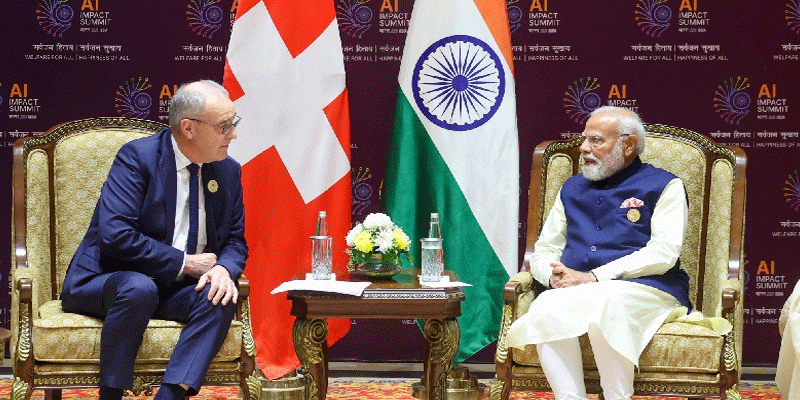
Despite the turbulence, faint signs of recalibration have emerged. Diplomatic exchanges resumed in mid-2025 with Prime Minister Narendra Modi’s visit to Ottawa and the appointment of new high commissioners on both sides. Educational institutions and policy groups are lobbying for a balanced approach—one that safeguards Canada’s regulatory integrity without alienating genuine students. Both governments have expressed intent to rebuild trust and restore predictability to student mobility frameworks.
Yet, significant obstacles remain: visa backlogs persist, policy changes continue to evolve, and the residue of diplomatic mistrust lingers. For many Indian families, the once-cherished Canadian dream now carries uncertainty and caution.
A Test of Trust and Transition
Canada’s student visa clampdown marks more than a policy correction—it represents a pivotal moment in India–Canada relations. The educational corridor that once symbolized openness and opportunity now stands clouded by suspicion and politics. While recovery is possible, it demands sincerity, transparency, and mutual respect from both sides. Only through deliberate bridge-building can this vital partnership reclaim its role as a cornerstone of trust and shared progress in the years ahead.
(With agency inputs)