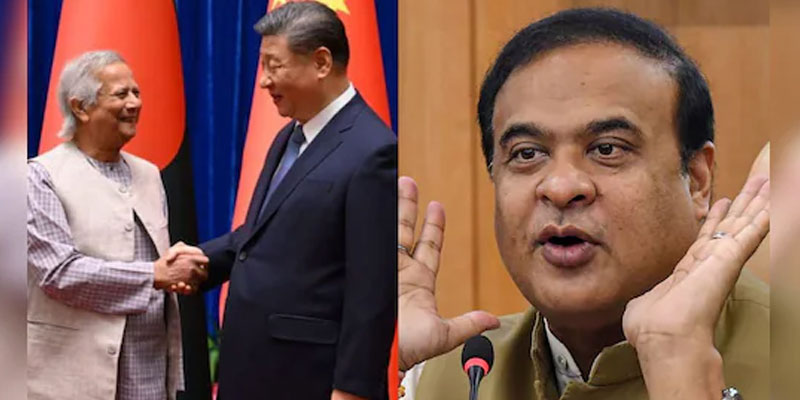
Defiance Abroad Amid Mounting Criticism at Home
Facing sustained criticism for failing to fully restore democratic normalcy and safeguard vulnerable minorities, Bangladesh’s outgoing Chief Adviser Muhammad Yunus used his farewell address to project defiance beyond his country’s borders. In remarks delivered just before the transition to a new political leadership, Yunus struck a nationalist tone and made indirect but provocative references touching on India’s northeastern region—comments that risk complicating ties with New Delhi at a delicate moment of political transition in Dhaka.
A Transitional Moment with Regional Implications
Yunus’s departure comes after an 18-month interim tenure marked by economic strain, political contestation, and scrutiny over minority safety. While he framed his administration as one that restored sovereignty and diplomatic confidence, critics argue that unresolved domestic issues overshadowed the narrative of stability. Against this backdrop, his exit speech blended domestic justification with an assertive foreign policy posture, signalling a potential recalibration in Bangladesh’s regional outlook.
Nationalist Rhetoric and Strategic Messaging
In his address, Yunus declared that Bangladesh would no longer appear “submissive” or dependent on external advice, presenting his tenure as a period of renewed autonomy in foreign affairs. He highlighted foreign exchange reserves and electoral developments as evidence of institutional recovery. However, the speech also served a political purpose—appealing to nationalist constituencies wary of perceived overreliance on India and receptive to a more diversified diplomatic approach.
Central to the controversy was his description of Bangladesh’s geographic position as a maritime gateway for regional economies, including Nepal, Bhutan, and India’s northeastern “Seven Sisters.” By grouping these regions together without explicitly referencing India as the sovereign framework, the remarks were widely interpreted as an indirect challenge to New Delhi’s sensitivities regarding territorial integrity and strategic vulnerabilities in the Siliguri Corridor.
India’s Official Response: Strategic Restraint
India has not issued a formal public statement through the Ministry of External Affairs specifically addressing Yunus’s latest comments. The absence of an immediate diplomatic rebuke reflects a calibrated approach. New Delhi appears to be prioritizing stability during Bangladesh’s leadership transition and maintaining engagement with the incoming administration rather than escalating tensions over a departing leader’s rhetoric.
This restraint is consistent with earlier actions. In late 2025, India had summoned Bangladesh’s envoy over similar narratives and concerns regarding minority safety. Yet in this instance, the focus has shifted toward resetting bilateral ties with the new government and advancing practical cooperation on trade, connectivity, and water-sharing issues. The invitation extended to Bangladesh’s new leadership for high-level engagement indicates that India is seeking continuity in dialogue despite the rhetorical friction.
China Factor and Regional Signalling
Yunus’s speech also underscored expanding ties with Beijing, including revived infrastructure and energy projects. By highlighting China’s role in Bangladesh’s economic recovery, he signalled a willingness to balance India’s influence with deeper engagement elsewhere. Such positioning aligns with a broader multipolar strategy but risks amplifying geopolitical competition in South Asia, particularly if references to India’s northeast are interpreted as part of a wider strategic narrative.
Rhetoric, Transition, and the Road Ahead
Yunus’s farewell address illustrates how domestic pressures can shape outward-facing diplomacy, especially during political transitions. While his remarks may resonate with nationalist audiences in Bangladesh, they have introduced avoidable sensitivities into an already complex bilateral relationship. India’s measured response suggests a preference for continuity and pragmatic engagement with Dhaka’s new leadership rather than confrontation. The coming months will determine whether the rhetorical assertiveness of the outgoing administration translates into lasting policy shifts—or whether both sides move toward a steadier, mutually beneficial reset in South Asian cooperation.
(With agency inputs)