A Shared Past, a Forward-Looking Future
The relationship between India and Japan has been rooted in cultural, spiritual, and economic exchanges for centuries. The compassion of Buddhism linked the two civilizations, while post-war solidarity and trade deepened ties. Over the decades, Japanese technology helped power India’s industries, just as Indian traders contributed to Japan’s commerce. This ancient connection is now transforming into a modern strategic partnership, one that aligns two major Asian democracies at a time of global flux.
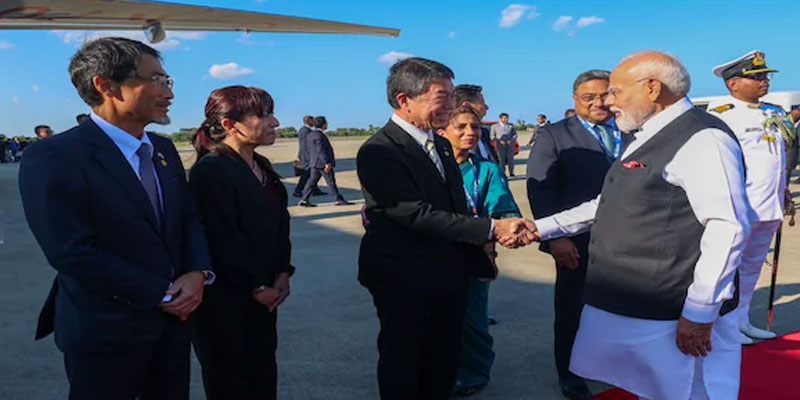
Prime Minister Narendra Modi’s recent two-day visit to Japan has underscored this trajectory, producing a slew of agreements in defence, space, technology, environment, and human resource exchange. The timing is critical: with India navigating trade tensions with Washington, New Delhi is signaling that its strategic options are far from limited.
MoUs Galore: From Climate to Space Exploration
During the visit, India and Japan signed multiple Memoranda of Understanding (MoUs) worth billions of dollars. These covered a wide spectrum—human resource development, cultural cooperation, environment, digital technologies, and space. Among the most notable was the Joint Crediting Mechanism, aimed at accelerating decarbonising technologies in India. By bringing Japanese green innovations into Indian infrastructure, the agreement supports India’s commitment to lowering emissions while unlocking fresh investment opportunities.
The cooperation in space exploration stands out as a scientific and symbolic leap. The Indian Space Research Organisation (ISRO) and the Japan Aerospace Exploration Agency (JAXA) will jointly launch Chandrayaan-5 to explore lunar water and volatile elements. With an ISRO-built lander and a Japanese rover launched aboard a JAXA rocket, the mission blends strengths of both agencies, further cementing India’s status as a serious space power.
Economic Synergy: ¥10 Trillion Commitment
Japan announced plans to invest ¥10 trillion (about ₹5.96 lakh crore) in India over the next decade, focusing on artificial intelligence, semiconductors, healthcare, and environmental sustainability. For India, this infusion not only promises jobs and innovation but also offers an alternative capital stream when Western investors are cautious.
PM Modi’s pitch for deeper business ties resonated strongly, particularly as Japan sees India as a reliable partner amid global supply chain disruptions. The initiative will also help India move closer to its ambition of becoming a global hub for advanced technology manufacturing.
Provincial Partnerships: Taking Ties Beyond Capitals
One of the visit’s unique features was Modi’s dialogue with Japanese governors. Stressing that cooperation should not remain confined to Tokyo and Delhi, he encouraged state-to-province partnerships. Examples already in motion include Gujarat–Shizuoka, Maharashtra–Wakayama, and Uttar Pradesh–Yamanashi.
Such linkages mirror Japan’s strong provincial economies—some larger than entire nations—and India’s diverse states, each with its own industrial strengths. Initiatives like “One District One Product” and the “Vibrant Village Program” are designed to harness regional potential, and Japan’s provinces can become natural collaborators in this journey.
Investing in Youth and Skills
The future of India–Japan relations lies in people-to-people exchanges. Recognizing this, Modi announced an action plan to send five lakh Indians to Japan in the next five years, including 50,000 skilled professionals. In return, Indian students will access Japan’s globally respected universities.
Startups and MSMEs will also benefit. A new Business Exchange Forum in Kansai will connect entrepreneurs from smaller cities of both countries, fostering innovation and joint ventures in emerging sectors. This emphasis on grassroots collaboration ensures that the partnership grows organically, not just through top-level diplomacy.
Cooperation in AI, Semiconductors, and Security
The two nations unveiled the Economic Security Cooperation Initiative, spanning artificial intelligence, semiconductors, and rare earth minerals. For India, which is seeking to reduce reliance on China in critical technologies, Japan’s expertise is invaluable.
Defence cooperation also deepened. With shared interests in maritime security in the Indo-Pacific, the two leaders agreed to expand collaboration in defence industry and innovation. This not only enhances strategic trust but also positions the partnership as a counterweight to regional challenges.
Strategic Balancing Amid US Pressure
The backdrop to this visit cannot be ignored. India’s trade ties with the United States are under strain due to protectionist tariffs and disagreements over market access. By showcasing its growing partnership with Japan, New Delhi is sending a subtle but clear signal: it has the capacity to diversify alliances and maintain strategic autonomy.
Japan, too, benefits from closer ties with India. As Tokyo recalibrates its role in global security and trade, India offers both a vast market and a like-minded partner committed to a free and open Indo-Pacific.
A Partnership for the 21st Century
PM Modi’s Japan visit was more than ceremonial—it was a carefully calibrated message of resilience and opportunity. With agreements spanning climate, technology, space, human capital, and defence, the partnership reflects both nations’ desire to shape a stable and innovative Asia.
At a time when global trade wars threaten established alignments, India’s engagement with Japan shows it is neither isolated nor constrained. Instead, it is proactively building a coalition of trust, innovation, and shared prosperity. If implemented with the same vigor as promised, the India–Japan partnership could emerge as one of the defining alliances of the 21st century—anchored in history, yet firmly directed toward the future.
(With agency inputs)