Policy and Promise
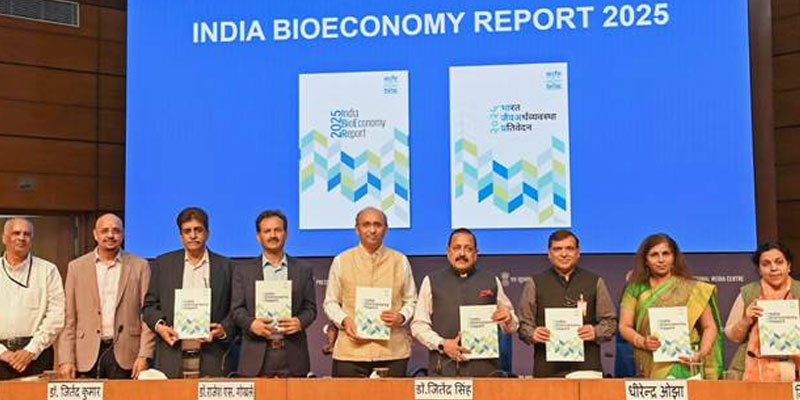
India’s bio-economy, once a fledgling sector, has grown into a major pillar of sustainable growth. Rooted in the country’s biotechnology policy framework, it integrates renewable resources, biotechnology, and industrial innovation to create value in food, energy, health, and environment. In 2014, India’s bio-economy was valued at just US$10 billion. A decade later, it is projected at US$165.7 billion in 2024—contributing 4.25% to the national GDP of US$3.89 trillion. With a target of US$300 billion by 2030, India is positioning itself as a global leader in green innovation and sustainable industry.
The bio-economy is not just about economics; it reflects India’s transition towards cleaner technologies, energy independence, and health innovation. By harnessing plants, animals, and microorganisms, India is reducing reliance on fossil fuels, cutting emissions, and advancing sustainable growth.
India’s bio-economy rests on four major sub-sectors, each contributing uniquely:
· Bio-industrial (47%) – Valued at US$78.2 billion, this sector is the largest, driven by biofuels, enzymes, bioplastics, and green chemicals. It has seen rapid adoption across industries, reflecting India’s growing shift towards sustainable practices.
· Bio-pharma & Biomedical (35.2%) – Worth US$58.4 billion, this segment underpins healthcare innovation. From affordable vaccines to precision medicine, cancer immunotherapy, and medtech devices, India has emerged as a key supplier to global health systems.
· Bio-agriculture (8.1%) – With a US$13.5 billion valuation, this sector promotes genetically modified crops, bio-based products, and precision farming. Bt cotton stands out as a transformative success, boosting yields and sustainability.
· Bio-research & Bio-IT (9.4%) – Valued at US$15.6 billion, it includes bioinformatics, contract research, clinical trials, and education. The rise of AI-powered biotech research is making India a competitive destination for global partnerships.
Achievements: From Ethanol to Vaccines
One of India’s landmark successes has been achieving 20% ethanol blending (E20) in petrol five years ahead of schedule. This move has not only provided cleaner fuel alternatives but also improved farmer incomes and saved significant foreign exchange. Since 2014, farmers have earned over ₹1.21 lakh crore through ethanol feedstock, while India saved ₹1.44 lakh crore in crude oil imports.
India has also consolidated its role as a global vaccine hub. Serum Institute of India alone expanded its share in the global vaccine market to 24% in 2024. Alongside, new therapies such as CAR-T cell treatments for cancer, AI-based diagnostics, and indigenous antibiotics like naphthromycin underscore India’s biomedical innovation.
Regional Drivers of Growth
India’s bio-economy is geographically diverse but strongly concentrated in certain regions. Maharashtra leads with US$35.45 billion (21.4%), followed by Karnataka (US$32.4 billion, 19.5%) and Telangana (US$19.9 billion, 12%). Southern states alone account for nearly half (45.4%) of the sector’s value, reflecting their robust biotech clusters. The West follows with 30.3%, while the North and East are emerging as growth frontiers.
This regional spread shows that while South India remains the biotech hub, other states are fast catching up, broadening the scope of innovation across the country.
Policy Push: BioE3 for Future Growth
To sustain momentum, the government introduced the BioE3 Policy (Biotechnology for Economy, Environment and Employment) in 2024. It emphasizes high-performance bio-manufacturing, bio-foundries, and innovation ecosystems. Coupled with startup support from BIRAC, India’s biotech startups are expected to grow from 5,365 in 2021 to 13,000 by 2025. Already, these startups have developed over 800 products and raised US$600 million in funding.
Foreign investment is also flowing in. The medtech sector alone attracted US$618 million in FDI by 2024, underscoring global confidence in India’s innovation capacity.
Climate and Global Potential
Beyond economics, India’s bio-economy holds promise for climate change mitigation. From carbon storage in agriculture and clean bio-energy to reducing food waste and promoting recycling, the sector directly supports India’s net-zero goals.
Globally, the bio-economy is projected to grow from US$4 trillion in 2020 to US$30 trillion by 2050, contributing around 12% of world GDP. India’s share is expected to rise sharply, with estimates placing its bio-economy at US$1.4–2.7 trillion by mid-century. This could account for up to 12% of India’s projected GDP of US$22 trillion in 2050.
A Superpower in the Making
India’s bio-economy is no longer an emerging story; it is a defining chapter of the country’s growth narrative. From vaccines and ethanol to precision farming and AI-driven healthcare, the sector symbolizes how innovation and sustainability can converge. The ambitious US$300 billion target by 2030 is not just aspirational—it is achievable, given current trajectories and global demand.
If nurtured with consistent policies, investment in research, and regional inclusivity, India’s bio-economy could transform into a global superpower by 2050. It represents not just economic opportunity but also a pathway to cleaner growth, energy security, and enhanced human well-being.
(With agency inputs)