Tariffs and Oil at the Core
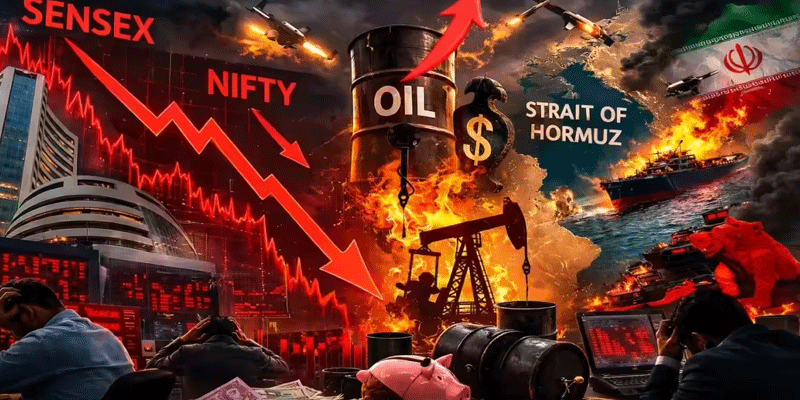
The Trump administration’s decision to target India with steep tariffs over its continued oil imports from Russia has sparked debate among policy analysts. While Washington insists that New Delhi must scale down its energy ties with Moscow, experts argue that such tactics are unlikely to succeed. India, they point out, has consistently defended its purchases as essential for energy security and even aligned with U.S. calls to stabilise volatile oil markets.
Expert Criticism of Trump’s Approach
Richard Rossow, chair of India and Emerging Asia Economics at the Center for Strategic and International Studies (CSIS), questioned the logic behind Washington’s latest moves. “Supporters of U.S.–India relations would like to see a reduction in India’s cooperation with Russia, but the pressure tactics adopted by President Trump, which apply only to India, don’t make much sense,” Rossow said.
His remarks followed comments by senior White House adviser Peter Navarro, who argued that “India should stay with us, not with Russia.” Navarro also accused New Delhi of “profiteering” from the Ukraine war, a charge strongly rejected by Indian Petroleum Minister Hardeep Singh Puri, who wrote in The Hindu that “the truth could not be farther from this.”
Navarro and Trump: A Shared Perspective
Rossow noted that Navarro’s criticism largely reflects Trump’s own worldview. Navarro has long been a close ally of the former president, and his remarks are often interpreted as carrying Trump’s approval. This alignment underscores why the administration has pursued a tariff-heavy approach against India, even though China and other states import greater volumes of Russian crude.
India’s Global Diplomacy in Context
The debate comes against the backdrop of Prime Minister Narendra Modi’s active diplomatic engagements. His participation in the Shanghai Cooperation Organisation summit in China, followed by bilateral talks with Russian and Chinese leaders, raised speculation of closer alignment. Rossow, however, dismissed such concerns, describing the SCO as a “meeting platform, not a working platform.” He emphasized that Modi’s Tokyo visit, where concrete announcements were made with Japan, held far more strategic weight for India’s foreign policy.
India–China Relations and Regional Balance
Rossow also welcomed ongoing efforts to reduce tensions between New Delhi and Beijing but cautioned against expectations of deep cooperation. China’s growing naval presence in the Indian Ocean and broader regional ambitions remain significant obstacles to trust.
He added that U.S. lawmakers have shown little initiative on the issue. Republicans are reportedly uneasy about Trump’s escalating stance, while Democrats remain absorbed in domestic priorities.
Pressure Without Purpose
By singling out India for punitive tariffs and public criticism, Washington risks undermining a partnership that has become central to its Indo-Pacific strategy. Experts argue that coercion is not the path forward; rather, constructive engagement and recognition of India’s energy needs will yield better results.
If the United States wishes to strengthen ties and limit Russian influence, it must adopt a more pragmatic approach—one that encourages cooperation instead of confrontation. Otherwise, Trump’s tariff-driven pressure strategy may achieve little beyond alienating one of America’s most important partners.
(With agency inputs)