Building skills for every stage of life
The government has outlined a comprehensive "life-cycle" approach to skill development, positioning it as the foundation for creating a future-ready workforce under the Viksit Bharat 2047 vision. Rather than treating skill development as a one-time intervention, the strategy seeks to integrate learning from school through employment, entrepreneurship and continuous reskilling. By linking education, vocational training, apprenticeships and advanced technology programmes, the government aims to transform India's demographic advantage into sustained economic productivity.
Why a life-cycle approach matters
Rapid technological change and evolving labour markets have made lifelong learning an economic necessity. The government's approach is based on the belief that employability depends on continuous acquisition and upgrading of skills rather than a single qualification earned early in life.
Within the broader Viksit Bharat 2047 roadmap, skill development complements investments in infrastructure, digitalisation and social inclusion. The objective is not merely to train larger numbers of people but to build a globally competitive workforce capable of adapting to changing industrial and technological demands.
Embedding skills from the classroom
A key pillar of the strategy is introducing vocational education much earlier in the learning journey. Under Samagra Shiksha, vocational education now spans 138 job roles across more than 25,000 schools, benefiting over 35.5 lakh students. Shared skill laboratories through the Hub-and-Spoke model further expand access to practical training.
The PM SHRI Schools initiative has grown to over 13,000 schools across 776 districts, integrating academic learning with practical skills and experiential education. Meanwhile, more than 10,000 Atal Tinkering Labs have encouraged over 1.1 crore students to explore innovation, robotics and problem-solving. Complementing these efforts, the National Skills Qualification Framework creates a competency-based pathway connecting school education with higher studies and employment, while the Vidyanjali Programme brings industry professionals into classrooms to strengthen real-world learning.
Expanding workforce skills and employability
Beyond schools, the Skill India Mission anchors large-scale workforce development. PMKVY 4.0 has trained over 28 lakh candidates across 36 sectors through thousands of institutions and Skill Hubs. Jan Shikshan Sansthans have trained more than 36 lakh beneficiaries since 2018, with women accounting for over 82% of participants.
Industry linkages have also strengthened through the National Apprenticeship Promotion Scheme, under which over 54 lakh apprentices have been engaged since 2016. Industrial Training Institutes continue expanding, while the PM-SETU programme seeks to modernise 1,000 government ITIs and establish National Centres of Excellence for Skilling.
These initiatives demonstrate a shift from isolated training programmes towards a broader ecosystem connecting education with employment.
Preparing for emerging technologies and entrepreneurship
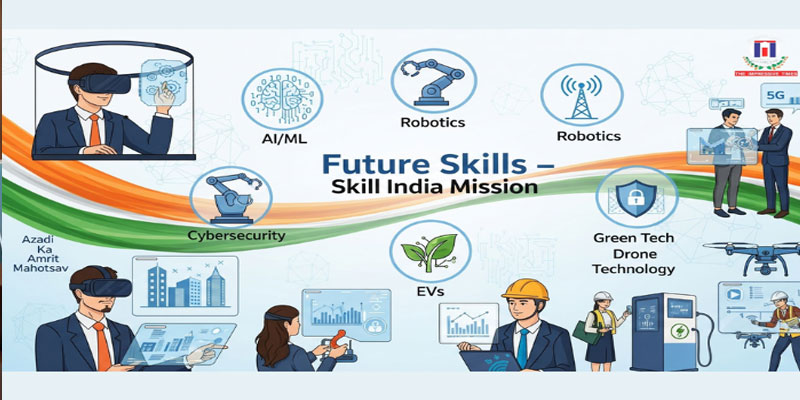
The government's future-ready strategy increasingly emphasises artificial intelligence, entrepreneurship and specialised skills. Under the IndiaAI Mission, AI education is expanding through hundreds of AI and Data Labs beyond metropolitan centres.
Complementary initiatives such as PM Vishwakarma, Startup India, AI Careers for Women and NAVYA aim to strengthen traditional occupations while preparing women and young people for emerging sectors including cybersecurity, digital marketing, green jobs and advanced manufacturing. Budget proposals for tourist guides, caregivers, AVGC content creators and university townships further reflect efforts to diversify India's future workforce.
Turning Scale into Sustainable Employment
India's life-cycle skilling framework represents an ambitious attempt to connect education, vocational training, apprenticeships and lifelong learning into a unified national talent strategy. Its strengths lie in scale, inclusion and a growing focus on future technologies. However, the real measure of success will extend beyond the number of people trained. Sustained outcomes will depend on improving training quality, tracking employment and earnings, reducing regional disparities and ensuring industries generate enough quality jobs to absorb an increasingly skilled workforce. If these challenges are effectively addressed, the strategy could become a cornerstone of India's journey towards becoming a developed economy by 2047.
(With agency inputs)