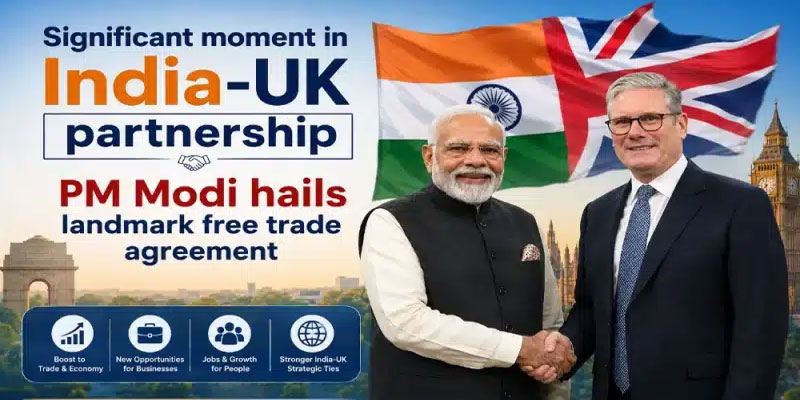
India and the United Kingdom have officially ushered in a new phase of bilateral economic cooperation as the India-UK Comprehensive Economic and Trade Agreement (CETA) came into force on July 15, 2026. The landmark pact immediately delivers lower tariffs, wider market access and greater mobility for professionals, marking one of the most significant trade milestones for both nations in recent years. While the agreement reduces trade barriers across goods and services, its broader significance lies in reshaping long-term commercial ties, strengthening supply chains and enhancing investment opportunities between two major economies.
A Landmark Trade Agreement
Signed in July 2025 after 14 rounds of negotiations, the India-UK Comprehensive Economic and Trade Agreement represents a comprehensive framework covering goods, services, investments and professional mobility. According to India's Ministry of Commerce and Industry, the agreement grants duty-free access to nearly 99% of Indian exports to the UK, benefiting both labour-intensive industries and high-value manufacturing.
The UK remains a crucial export destination for Indian products such as textiles, leather goods, marine products, engineering items, gems and jewellery, while also serving as a major market for IT services, consulting, education and financial services. Covering 137 service sub-sectors, the agreement significantly expands opportunities for Indian businesses and professionals operating in the British market.
Top 10 Changes Under the India-UK Trade Deal
· Duty-free access for exports: Nearly 99% of Indian exports to the UK now enjoy zero customs duty, making Indian products significantly more competitive.
· Boost for labour-intensive industries: Garments, textiles, footwear, carpets and processed food products will now enter the UK duty-free instead of attracting tariffs ranging from 4% to 16%.
· Expanded opportunities for key export sectors: Marine products, leather goods, toys, sports equipment, gems and jewellery gain broader access to UK markets, potentially increasing export orders.
· Improved prospects for automobile exports: Indian automobile and auto-component manufacturers receive better market access, while UK vehicle imports into India will benefit from phased tariff reductions under specified quotas.
· Cheaper premium British cars: Import duties on fully built UK passenger vehicles will gradually decline from 110% to 10%, making premium British automobiles more affordable over time.
· Lower duties on Scotch whisky: Tariffs on Scotch whisky will reduce from 150% to 75% initially and gradually fall to 40% over the next decade, lowering retail prices.
· Greater access for service providers: Indian firms in IT, consulting, finance, legal services, architecture, engineering and education gain improved access across 137 service sectors.
· Relief from double social-security payments: Indian professionals temporarily working in the UK can avoid paying social-security contributions in both countries for up to five years under the Double Contribution Convention.
· Lower deployment costs for Indian companies: Major firms such as TCS, Infosys and other multinational service providers are expected to benefit from easier staff mobility and reduced employment costs.
· Greater consumer benefits: UK consumers are likely to enjoy more competitively priced Indian clothing, food products and footwear, while India strengthens its position in services and investment partnerships.
Impact: Beyond Tariff Reductions
The agreement's biggest beneficiaries are expected to be India's export-oriented manufacturers and globally competitive service providers. By combining tariff elimination with services liberalisation and professional mobility, the pact creates new opportunities for businesses to expand into one of Europe's largest markets. It also reduces costs for Indian companies deploying skilled professionals abroad while encouraging higher bilateral investments.
For the UK, the agreement promises access to competitively priced Indian goods, easier engagement with Indian talent and stronger commercial links with one of the world's fastest-growing major economies. The phased reduction in duties on premium products is also expected to stimulate consumer demand and business partnerships.
A Foundation for Stronger Economic Partnership
With the India-UK trade agreement now operational, attention shifts from negotiations to implementation. The success of the pact will depend on how effectively businesses utilise the new market access, tariff benefits and mobility provisions to expand trade and investment. If executed efficiently, the agreement has the potential to deepen bilateral economic integration, strengthen supply chains and establish a more resilient and future-ready partnership between India and the United Kingdom.
(With agency inputs)