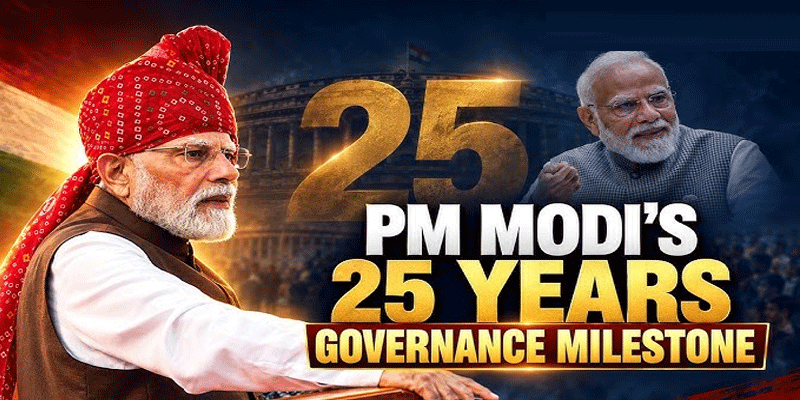
Prime Minister Narendra Modi has completed 25 uninterrupted years at the helm of an elected government, marking a rare political journey from Gujarat’s Chief Minister’s Office to three consecutive terms as India’s Prime Minister. On October 7, 2001, he assumed office as Gujarat Chief Minister; after more than 12 years in the state, he moved to national politics and became Prime Minister in 2014. His third consecutive term began in June 2024.
From Gujarat to the National Stage
Modi’s political foundations were shaped by his association with the Rashtriya Swayamsevak Sangh and subsequent organisational responsibilities in the Bharatiya Janata Party. His tenure in Gujarat established him as an administrator with a strong political communication style, while the BJP’s 2014 Lok Sabha victory transformed him into a national leader.
The electoral journey demonstrated remarkable political endurance. The BJP won 282 seats in 2014 and increased its tally to 303 in 2019. In 2024, it secured 240 seats but returned to power under the National Democratic Alliance, making coalition partners important to the government’s majority.
The Architecture of Political Endurance
Modi’s longevity has been driven by a combination of leadership appeal, organisational strength, welfare delivery and a sustained development narrative. His governance model has increasingly focused on making government schemes more visible and directly accessible to citizens.
Among the major initiatives and achievements associated with his tenure are:
· Financial inclusion: Jan Dhan accounts and expanded access to formal banking.
· Digital transformation: Aadhaar-linked services, Direct Benefit Transfers and the rapid expansion of UPI.
· Tax reform: Introduction of the Goods and Services Tax to create a more integrated national market.
· Infrastructure: Major expansion of highways, railways, airports, logistics networks and urban infrastructure.
· Housing and basic services: Expansion of affordable housing, household tap-water connections and sanitation coverage.
· Manufacturing: Make in India, production-linked incentives and efforts to strengthen domestic manufacturing and supply chains.
· Global positioning: A more prominent Indian role in international forums, strategic partnerships and global economic diplomacy.
Together, these initiatives have helped shape the government’s broader narrative of a more digitally enabled, infrastructure-focused and delivery-oriented state.
From Development to Viksit Bharat
The next stage of Modi’s political narrative is increasingly centred on Viksit Bharat 2047—the ambition of transforming India into a developed nation by the centenary of independence.
Addressing the Viksit Bharat Sankalp Sabha, Modi reinforced that ambition with a simple message: “We will do it.” He linked the phrase to major national aspirations, including achieving Viksit Bharat by 2047, hosting the Olympics and advancing India’s space capabilities.
His emphasis on service was equally significant. Saying, “For me, the people are God,” Modi presented public office as a responsibility rooted in citizens’ trust. His assertion that he remains “a student” also underlined his emphasis on continuous learning as an instrument of public service.
The Next Test: Turning Resolve into Results
Twenty-five years of uninterrupted governance represents political endurance, but the larger test lies ahead. India’s journey towards Viksit Bharat will require stronger institutions, high-quality employment, technological leadership, globally competitive manufacturing and inclusive economic growth.
The first 25 years established Modi’s political journey; the next 21 years will determine how convincingly that journey translates into a developed India by 2047.
(With agency inputs)