Modi Arrives in Norway After Four-Decade Diplomatic Gap
Prime Minister Narendra Modi arrived in Norway on Monday during the fourth leg of his five-nation diplomatic tour, marking the first visit by an Indian Prime Minister to the Nordic nation in more than four decades. The last such visit took place in 1983, at a time when global geopolitics, economic alignments and India’s international priorities were vastly different.
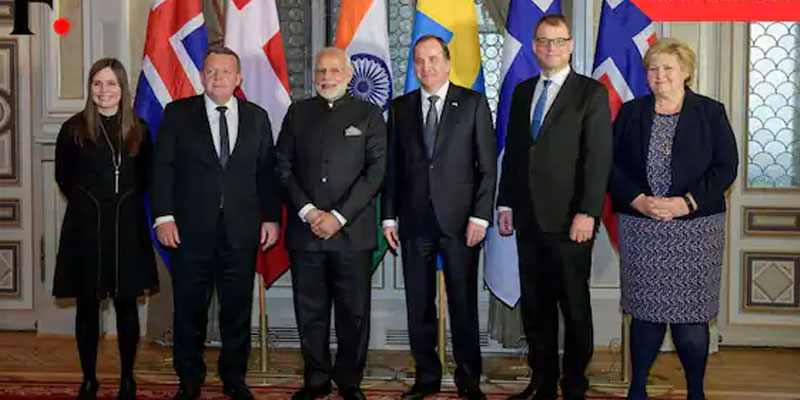
Modi’s Oslo visit is therefore being viewed not merely as a ceremonial stop but as a strategic re-engagement with the Nordic region, which has become increasingly influential in areas such as climate governance, renewable energy, Arctic policy, maritime security and advanced technology cooperation. The visit’s central event is the third India-Nordic Summit involving leaders from Norway, Denmark, Sweden, Finland and Iceland.
The Evolution of India-Nordic Relations
India’s structured engagement with the Nordic countries began gaining momentum with the first India-Nordic Summit in Stockholm in 2018, followed by another summit in Copenhagen in 2022. Initially focused on innovation, sustainability and digital governance, the partnership has steadily evolved into a broader strategic relationship.
The Nordic countries occupy a unique space in global politics because of their leadership in green technologies, clean-energy transitions and welfare-driven economic models. For India, these nations offer valuable expertise in renewable energy, urban sustainability, digital public infrastructure and smart manufacturing.
Trade relations have also deepened steadily. India’s trade with the Nordic bloc has crossed nearly $19 billion, covering sectors such as maritime equipment, healthcare technology, renewable-energy systems and engineering goods. This growing economic relationship aligns with India’s broader strategy of diversifying trade and technology partnerships beyond traditional Western centres.
Oslo Summit And Strategic Priorities
The third India-Nordic Summit is expected to focus heavily on green transition initiatives, critical technologies, cybersecurity, artificial intelligence and defence cooperation. Another emerging area of collaboration is Arctic research and ocean governance, particularly as climate change increases the geopolitical importance of northern sea routes and environmental monitoring.
During the visit, Modi is also expected to hold bilateral talks with Norwegian Prime Minister Jonas Gahr Store and meet the Norwegian royal family. Discussions are likely to include maritime security, defence-industry collaboration, offshore energy projects and joint scientific research.
The summit also reflects India’s effort to position itself as a serious partner in future-oriented sectors rather than merely a large consumer market.
Economic Impact and The India-EFTA Agreement
A major economic backdrop to the Norway visit is the India-EFTA Trade and Economic Partnership Agreement, operational since October 2025. The pact links India with the European Free Trade Association countries, including Norway, and significantly reduces tariff barriers.
The agreement offers Indian exporters duty-free access to most EFTA markets while enabling Nordic countries to expand exports of renewable-energy technology, healthcare products and maritime systems to India. It also eases mobility for Indian professionals and IT services, potentially strengthening India’s role in Europe’s high-value digital economy.
For India, the arrangement is strategically important because it combines investment, technology transfer and market access with long-term climate and infrastructure goals.
Beyond Diplomacy Toward Strategic Alignment
Modi’s Norway visit symbolises a wider transformation in India’s foreign policy priorities. The Nordic region is no longer viewed solely as a niche economic partner but as an important strategic collaborator in areas shaping the future global order — climate policy, critical technology, digital governance and sustainable growth.
As geopolitical competition intensifies and nations seek resilient partnerships, India’s outreach to the Nordic-EFTA axis reflects a calculated effort to build deeper alliances rooted in innovation, sustainability and strategic trust.
(With agency inputs)