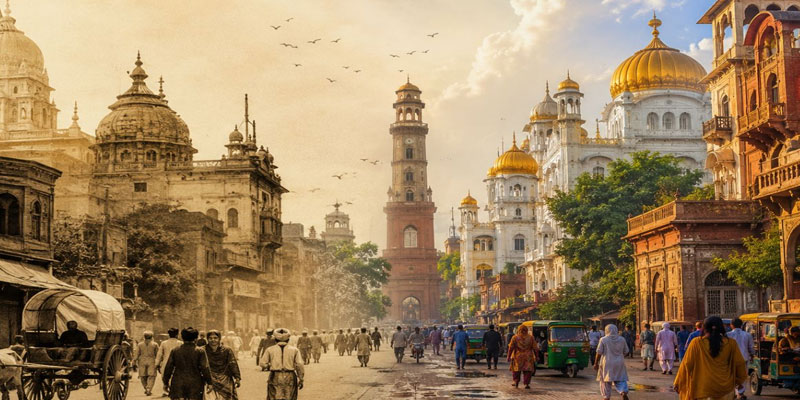
Pakistan’s Punjab government has approved a sweeping restoration of several pre-Partition and colonial-era place names across Lahore, marking one of the most symbolically significant heritage initiatives in the city’s recent history. Backed by former Prime Minister Nawaz Sharif and Punjab Chief Minister Maryam Nawaz, the Lahore Heritage Area Revival plan seeks to revive the city’s multicultural past by restoring Hindu, Sikh, Jain, and British-era place names that had been changed during later phases of Islamisation and political restructuring. The move is being presented as both a heritage-revival exercise and a tourism-driven urban transformation project, though it also touches deeper debates around identity, memory, and Pakistan’s historical narrative.
What the Renaming Initiative Includes
The project primarily targets Lahore’s historic walled city and adjoining central neighbourhoods, where many localities had been renamed during the 1990s to honour Islamic figures or personalities linked to the Pakistan Movement. Under the new plan, authorities are reinstating names associated with Lahore’s pre-1947 social and cultural landscape.
The initiative extends beyond religious symbolism and also restores several colonial-era names connected to Lahore’s urban history. Officials argue that the exercise is aimed at preserving historical continuity rather than promoting any particular ideological agenda. Alongside the renaming project, the government is also restoring the city’s historic gates and heritage structures, linking physical conservation with cultural memory.
Key Names Being Restored
Some of the most notable changes have already attracted public attention.
Islampura has officially reverted to Krishan Nagar, reviving the locality’s historical Hindu-linked identity. Babri Masjid Chowk is once again being called Jain Mandir Chowk, referencing the area’s pre-Partition Jain heritage. Sunnatnagar has been renamed Santnagar, while Mustafaabad is returning to its older name, Dharampura.
Another widely discussed change is the renaming of Maulana Zafar Ali Khan Chowk back to Lakshmi Chowk, a historic cultural hub long associated with Lahore’s artistic and theatrical traditions. Similarly, Rehman Gali is reverting to Ram Gali.
Authorities are also working to restore all eight gates of the old city, including the iconic Delhi Gate, further reinforcing Lahore’s image as a historically layered South Asian metropolis.
Why the Move Holds Political and Cultural Significance
The renaming exercise carries implications far beyond urban administration. Supporters view the move as an overdue recognition of Lahore’s pluralistic and multicultural roots. Before Partition in 1947, Lahore was home to thriving Hindu, Sikh, Muslim, and Jain communities whose influence shaped the city’s architecture, commerce, literature, and social life.
By reviving older names, the Punjab government is implicitly acknowledging that Lahore’s history cannot be reduced to a single religious or ideological identity. The initiative also has practical benefits for heritage tourism, historical research, and diaspora communities seeking to reconnect with ancestral neighbourhoods.
However, the decision may also generate political debate. Critics could interpret the rollback of Islamist-era names as a challenge to narratives that emphasized Pakistan’s Islamic identity during previous decades. For others, the initiative represents an attempt to reclaim a more inclusive historical memory without undermining Pakistan’s national identity.
Reclaiming Lahore’s Layered Historical Memory
The Lahore renaming initiative reflects a broader struggle over how cities remember their past and define their future. By restoring pre-Partition and colonial-era names, Punjab’s leadership is attempting to revive Lahore’s image as a historically diverse cultural center rather than a city shaped solely by post-Partition politics. Whether viewed as heritage preservation, political symbolism, or historical correction, the move signals a notable shift in how Pakistan’s urban history and multicultural legacy are being publicly reinterpreted.
(With agency inputs)