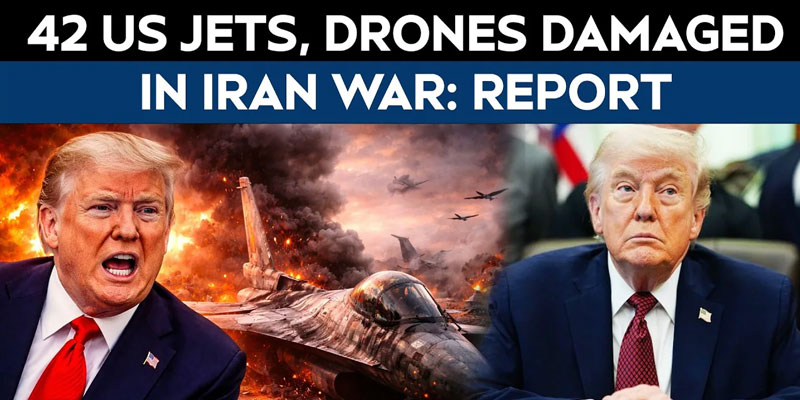
The United States has reportedly lost or suffered damage to at least 42 military aircraft during its ongoing conflict with Iran, highlighting the mounting human, strategic, and financial costs of the war. According to a new Congressional Research Service (CRS) report, the losses include advanced fighter jets, surveillance aircraft, helicopters, and a significant number of MQ-9 Reaper drones. The Pentagon has also estimated the overall operational cost of the campaign at nearly 29 billion dollars, underscoring how rapidly the conflict is draining military resources while reshaping debates around modern warfare.
Expanding Conflict and Rising Consequences
The conflict between the United States and Iran has evolved into one of the most complex military confrontations in recent years, involving air operations, drone warfare, intelligence missions, and strategic strikes across contested regions. What began as a targeted campaign against Iranian-linked military infrastructure has gradually expanded into a prolonged operation requiring continuous deployment of air and naval assets.
As military engagements intensified, the consequences became increasingly visible. Beyond geopolitical instability in West Asia, the conflict has strained defence budgets, heightened regional tensions, and raised concerns over the sustainability of prolonged military operations in highly contested airspace.
The latest CRS findings now offer a clearer picture of the scale of military attrition faced by the United States during the campaign.
Breakdown Of the Aircraft Losses
According to the report, the 42 affected aircraft are linked specifically to “Operation Epic Fury,” launched on February 28 against Iranian targets. The losses reportedly include four F-15E Strike Eagle fighter jets, one F-35A Lightning II stealth fighter, one A-10 Thunderbolt II attack aircraft, seven KC-135 Strat tanker refuelling aircraft, one E-3 Sentry AWACS surveillance aircraft, two MC-130J Commando II aircraft, one HH-60W Jolly Green II helicopter, 24 MQ-9 Reaper drones, and one MQ-4C Triton surveillance drone.
The CRS noted that the figures remain provisional because some incidents are still classified, while others may involve accidents or deliberate destruction to prevent sensitive technology from falling into enemy hands.
The dominance of drone losses in the list reflects the increasing dependence on unmanned systems in modern combat operations. Although drones reduce pilot casualties, they remain extremely expensive and strategically valuable assets.
Strategic And Financial Pressures
Military analysts believe the loss of support and surveillance aircraft may prove more damaging than fighter losses alone. Tankers, AWACS aircraft, and special operations transports serve as the backbone of long-range military campaigns, enabling coordination, refuelling, and intelligence gathering across vast operational zones.
At the same time, the financial burden of the war continues to rise sharply. Acting Pentagon Comptroller Jules W. Hurst III informed lawmakers that operational costs had increased from roughly 25 billion dollars in April to nearly 29 billion dollars by mid-May. Much of the increase stems from replacing damaged aircraft, repairing equipment, maintaining deployed forces, and replenishing precision-guided munitions.
The scale of losses has also intensified political debate in Washington. Lawmakers are increasingly questioning whether the Pentagon has fully accounted for all operational risks and whether the current military strategy remains sustainable in the long term.
Rethinking Modern Military Strategy
The reported loss of 42 aircraft in the Iran conflict represents more than a battlefield statistic. It highlights the vulnerabilities even technologically superior militaries face in modern high-threat warfare. The growing dependence on drones, surveillance systems, and support aircraft has expanded operational reach but also created new points of strategic weakness. As costs escalate and attrition mounts, the conflict is likely to force the United States to reassess not only the duration of its campaign against Iran, but also the broader future of air power, military spending, and modern combat strategy.
(With agency inputs)