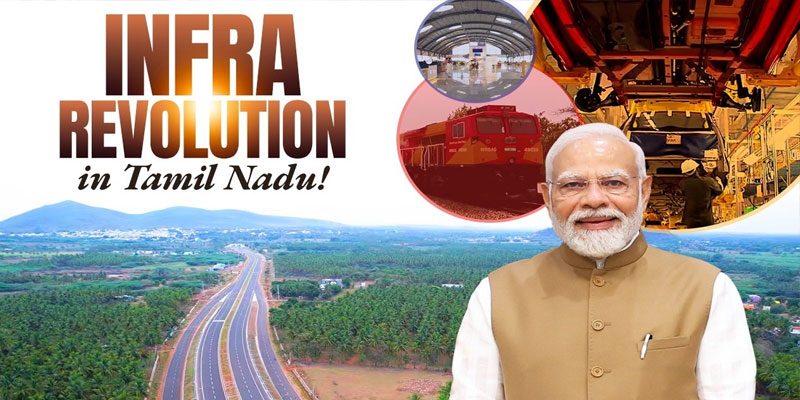
Prime Minister Narendra Modi is set to visit Chennai on October 11 to inaugurate development initiatives, dedicate completed infrastructure and lay foundation stones for projects worth more than ₹13,000 crore across Tamil Nadu. The package spans urban transport, highways, railways, maritime infrastructure, petroleum production and advanced scientific research, with the Chennai Metro’s Poonamallee–Vadapalani corridor emerging as its centrepiece.
Infrastructure Push for a Growing Economy
Tamil Nadu’s expanding industrial base, rapid urbanisation and increasing freight movement have intensified the need for modern transport and logistics infrastructure. Chennai faces persistent traffic congestion, while improved railway and highway connectivity is crucial for industrial centres and ports across the state.
The Centre’s latest package aims to strengthen these networks while advancing domestic manufacturing and scientific research. The visit also carries political significance, with Modi and Tamil Nadu Chief Minister C. Joseph Vijay scheduled to make their first joint public appearance since Vijay assumed office.
Chennai Metro and Highways Take Centre Stage
The principal highlight is the inauguration of the 14.6-kilometre Poonamallee–Vadapalani stretch of Chennai Metro Phase II, developed at a cost of approximately ₹4,900 crore. It is the first operational section of the planned 118.9-kilometre Phase II expansion.
Key features include:
· A 3.7-kilometre double-decker structure incorporating advanced engineering.
· Modern signalling systems designed to support driverless train operations.
· Improved connectivity across western Chennai, potentially reducing road congestion and commuting times.
Modi is scheduled to travel on the corridor between Poonamallee Bypass and Porur Bypass.
Separately, national highway projects worth approximately ₹3,700 crore will be inaugurated or receive foundation stones, improving regional connectivity and facilitating freight movement.
Railways and Ports Strengthen Trade Connectivity
Railway projects worth more than ₹750 crore will be dedicated to the nation. These include the Karaikal–Peralam railway line and three rail flyovers in and around Coimbatore, intended to improve connectivity, reduce delays and enhance road safety.
The programme will also cover five redeveloped Amrit Stations: Palani, Vellore Cantonment, Ambasamudram, Paramakkudi and Namakkal. Port and maritime-logistics initiatives are expected to complement these investments by improving the movement of goods and strengthening Tamil Nadu’s trade infrastructure.
Petroleum and Brain Research Advance Self-Reliance
At Chennai Petroleum Corporation Limited’s Manali refinery, Modi will lay the foundation stone for a ₹1,620-crore Lube Oil Base Stocks project. The facility aims to expand domestic production of specialised lubricant ingredients and reduce import dependence.
At IIT Madras, he will dedicate the Sudha Gopalakrishnan Brain Centre. Its research mission includes creating three-dimensional, cellular-resolution brain atlases from more than 100 human brains across different stages of life, potentially advancing neuroscience and medical research.
Execution Will Determine Economic Returns
The ₹13,000-crore-plus package represents a broad investment in Tamil Nadu’s transport infrastructure, industrial capabilities and scientific ecosystem. If implemented effectively, it could improve urban mobility, strengthen supply chains, create economic opportunities and support technological advancement.
However, announcements alone cannot guarantee results. Timely completion, reliable services, effective transport integration and measurable benefits for citizens and businesses will ultimately determine the success of these projects. The challenge now is to translate investment commitments into lasting improvements in Tamil Nadu’s economic competitiveness and everyday public services.
(With agency inputs)