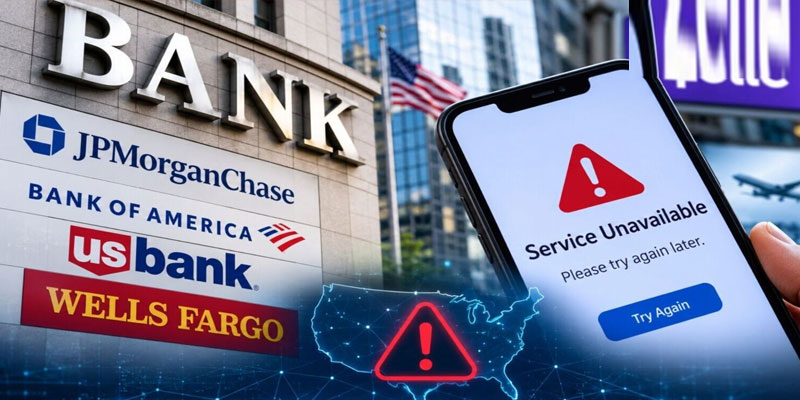
A technical failure at JPMorgan Chase disrupted banking transactions across the United States on November 16, triggering thousands of customer complaints and raising concerns about the resilience of interconnected financial infrastructure.
Customers reported difficulties accessing banking applications, checking account balances, and completing payments involving major institutions, including Bank of America, Wells Fargo, and US Bank.
According to outage-monitoring platform Downdetector, complaints peaked around 2 p.m. Eastern Time before gradually declining, suggesting that the disruption affected customers across multiple banking channels.
JPMorgan Chase confirmed that the problem originated from a software bug affecting its on-premises hardware systems, explicitly ruling out evidence of a cyberattack.
The banking giant acknowledged that some transactions were taking longer than usual but assured customers that their accounts and funds remained accessible.
Importantly, Chase clarified that the incident was not a systemic banking failure. Other institutions experienced delays primarily when processing transactions involving JPMorgan's infrastructure.
US Bank similarly confirmed that its internal systems remained operational, although customers transferring money through Zelle could encounter delays involving participating financial institutions.
Zelle's operator, Early Warning Services, maintained that its payment network was functioning normally, distinguishing individual bank processing problems from a network-wide outage.
The incident nevertheless demonstrates how operational dependencies can transmit disruptions across financial institutions, even when their underlying technology platforms remain unaffected.
Coming shortly after separate technology outages affecting Microsoft services and US aviation infrastructure, the banking disruption highlights growing concerns surrounding software reliability, infrastructure modernization, and operational continuity.
The larger lesson is that cybersecurity alone cannot guarantee banking resilience. Financial institutions must strengthen software testing, system redundancy, automated monitoring, transaction recovery, and disaster preparedness. As digital banking becomes increasingly interconnected, maintaining customer confidence requires both protection against malicious attacks and the ability to withstand unexpected technical failures.