Cabinet Approval: Project, Contractor and Funding
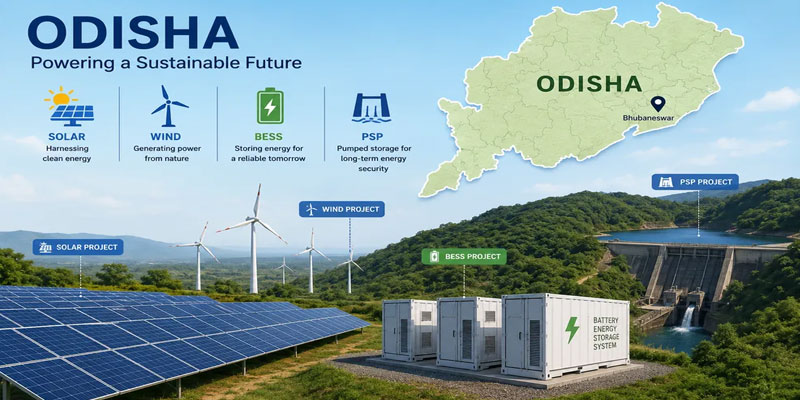
Odisha’s Cabinet has approved a proposal for a ₹4,708.64-crore pumped-storage power project, marking a significant step towards strengthening the state’s energy infrastructure. The 600 MW Upper Indravati Pumped Storage Project (PSP), to be developed at Ranibahal in Kalahandi district, is being positioned as Odisha’s first pumped-storage facility. Implemented by Odisha Hydro Power Corporation Ltd (OHPC), the project is targeted for commissioning in the financial year 2030-31.
At its meeting on November 9, 2026, the Cabinet approved the project's construction framework, financing arrangement and execution plan. Megha Engineering & Infrastructures Ltd (MEIL) has been selected as the engineering, procurement and construction (EPC) contractor.
The key approved details include:
· Installed capacity: 600 MW.
· Total project cost: ₹4,708.64 crore, including GST, consultancy, land acquisition, forest clearances and interest during construction.
· EPC contract value: ₹3,372.88 crore, excluding GST.
· Implementing agency: OHPC.
· Financing: 80% through a state government soft loan and 20% through OHPC's internal reserves.
· Commissioning target: FY 2030-31.
The state government's soft loan will carry interest linked to the Reserve Bank of India's repo rate.
How Pumped-Storage Technology Works
Pumped-storage hydropower essentially functions as a giant rechargeable battery. During periods of low electricity demand or surplus generation, electricity is used to pump water from a lower reservoir to an upper reservoir. When demand rises, the stored water is released through turbines to generate electricity.
The Upper Indravati project is expected to generate approximately 1,040 million units (MU) of peak electricity annually while consuming around 1,283 MU for pumping. The difference reflects energy conversion losses and the efficiency limitations inherent in storage technology.
Its primary advantage is the ability to store electricity when it is available and deliver it when required.
Why The Project Matters for Odisha
With industrial expansion and growing renewable-energy capacity, Odisha needs reliable electricity and greater flexibility in managing demand. The 600 MW facility can provide:
· Peak-hour electricity to meet increased demand.
· Grid balancing and frequency regulation.
· Spinning reserves and black-start support.
· Greater integration of intermittent solar and wind power.
· Reduced dependence on conventional fossil-fuel-based peaking generation.
Financial And Execution Challenges
Despite its strategic importance, the project faces several challenges. The substantial state-backed financing commitment will require a commercially sustainable revenue model. Earnings from peak-power sales, energy-price differences, capacity payments and grid-support services will be crucial.
Construction must also overcome potential delays involving land acquisition, forest clearances, geological conditions, reservoir-related works and transmission connectivity. Cost escalation and timely completion will remain important concerns.
A Strategic Investment in Odisha's Energy Future
The Cabinet approval, part of a wider package of 13 proposals, represents more than an infrastructure investment. It signals Odisha's recognition that future energy security will depend not only on generating more electricity but also on storing and managing it efficiently. If executed on schedule and supported by a viable commercial framework, Upper Indravati could become a cornerstone of the state's transition towards a more flexible, reliable and renewable-energy-ready power system.
(With agency inputs)