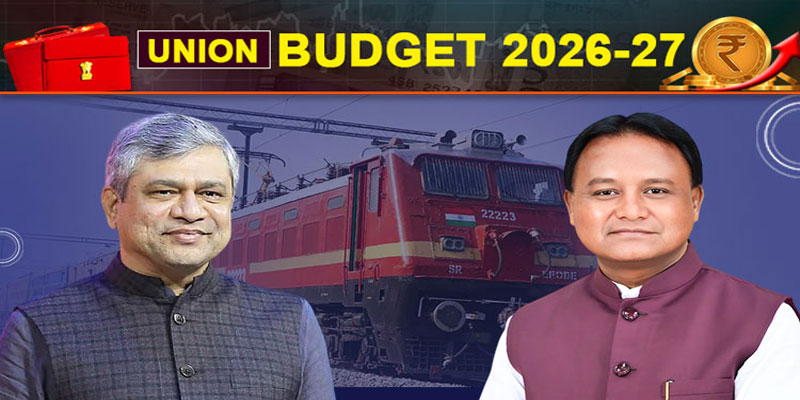
Odisha has emerged as a major beneficiary of the Union Budget 2026–27, securing an unprecedented ₹10,928 crore allocation for railways—the highest ever for the state. Announced by Railway Minister Ashwini Vaishnaw, the outlay marks a clear step-up from last year’s ₹10,599 crore and represents a dramatic rise from the pre-2014 annual average of under ₹900 crore. The scale of funding underlines the Centre’s growing focus on strengthening eastern India’s infrastructure backbone.
Railways as Odisha’s Growth Spine
Railway investment in Odisha is no longer confined to incremental upgrades. With projects worth over ₹90,000 crore already underway and a stated ambition to cross ₹1 lakh crore by 2029, railways are being positioned as the core enabler of industrial expansion, logistics efficiency, and regional integration. The Budget allocation covers new lines, doubling projects, station redevelopment, full electrification, and advanced safety systems—laying the groundwork for long-term economic transformation.
At the centre of this push lies a game-changing logistics project: the East–West Dedicated Freight Corridor (EWDFC).
The East–West Freight Corridor: A Structural Advantage
The 2,052-km EWDFC, stretching from Dankuni in West Bengal to Surat in Gujarat, cuts across Odisha and links seamlessly with the Eastern and Western Dedicated Freight Corridors. Designed for heavier axle loads and higher speeds than conventional rail, it fundamentally alters how bulk commodities move across the country.
For Odisha, a mineral-rich but logistics-constrained state, this corridor is pivotal. It enables faster and cheaper transport of coal, iron ore, bauxite, steel, cement, and aluminium from inland production centres to ports and consumption hubs in western and northern India.
How the Corridor Benefits Odisha’s Industries
· Lower Logistics Costs and Faster Turnaround
Industries in Odisha currently face logistics costs that erode competitiveness. The EWDFC is expected to cut freight costs by 30–40% and halve transit times, particularly for long-haul movements to western ports like JNPT and Kandla. Reduced congestion and predictable schedules also lower inventory and working capital requirements.
· Steel and Mining Expansion
Steel clusters in Angul, Kalinganagar, and Sundargarh—home to major players such as Tata Steel and JSW—stand to gain the most. The corridor allows high-volume movement of iron ore and coal, supporting capacity expansion and improving export viability. Ancillary ferro-alloy and pellet plants also benefit from smoother east–west connectivity.
· Aluminium, Cement, and Power
Odisha’s aluminium ecosystem, including NALCO’s Angul complex, depends heavily on efficient coal and raw material transport. Cheaper freight improves margins and export competitiveness. Cement manufacturers gain similar advantages, particularly in accessing western and southern markets.
· Ports, MSMEs, and Industrial Clusters
The corridor strengthens linkages to Paradip and Dhamra ports, enhancing Odisha’s role in global supply chains. MSMEs supplying components, logistics services, and maintenance are likely to see spillover growth as freight volumes scale up.
· Beyond Freight: Complementary Infrastructure Gains
The railway push is complemented by 100% electrification, AI-enabled safety measures such as thermal cameras for wildlife protection, and integration with inland waterways like National Waterway-5. Together, these initiatives improve sustainability while amplifying the impact of rail-led growth.
From Transit State to Industrial Hub
Odisha’s record railway allocation marks more than a budgetary win—it signals a structural reorientation of the state’s economic role. By anchoring industrial growth to the East–West Freight Corridor, Odisha is poised to convert its natural resource advantage into durable manufacturing and export strength. Execution risks remain, but if projects stay on track, railways could become the engine that propels Odisha into the front rank of India’s next growth phase.
(With agency inputs)