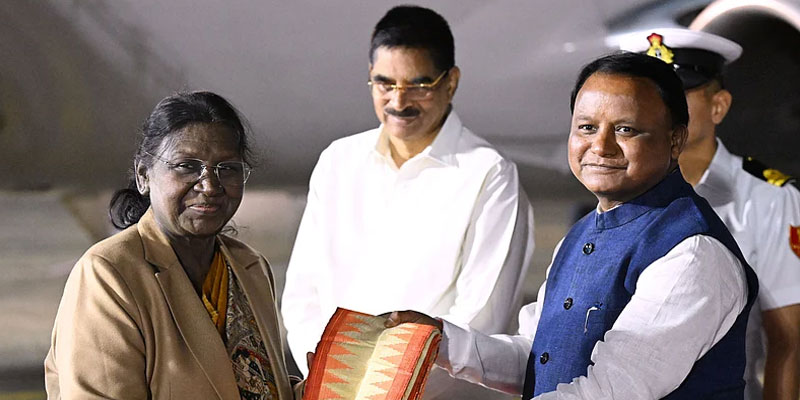
President Returns to Her Roots
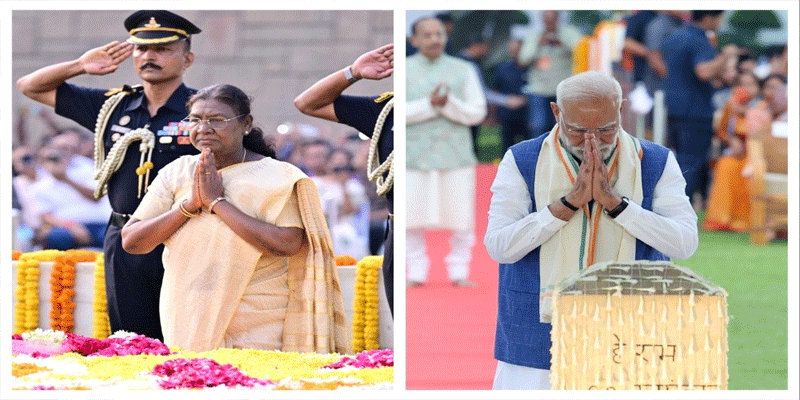
President Droupadi Murmu began a six-day visit to Odisha—her home state—on February 2, marking one of her most extensive engagements in the region since assuming office. Spanning key districts including Khurda, Jajpur, Balasore, Puri, and Mayurbhanj, the visit blends personal symbolism with public purpose, reflecting both her deep roots in the state and Odisha’s evolving development narrative.
A Programme That Balances Culture and Governance
Arriving in Bhubaneswar on the evening of February 2, the President’s itinerary was designed to combine spiritual observances, academic engagement, tribal outreach, and the inauguration of development assets. The visit holds special significance as Murmu is Odisha’s first tribal President and hails from Mayurbhanj, a predominantly tribal district that features prominently in her schedule.
Her programme underscores a deliberate effort to link constitutional office with grassroots engagement—particularly in education, women’s empowerment, tribal welfare, and regional infrastructure.
A Closely Sequenced Schedule Across Districts
February 3 saw an intensive cross-district itinerary. The President began the day in Jajpur, offering prayers at the revered Maa Biraja Temple, one of Odisha’s prominent Shakti Peeths. The visit highlighted her continued spiritual association with Odisha’s cultural traditions.
From Jajpur, she travelled to Balasore to preside over the 12th convocation of Fakir Mohan University. Addressing graduating students, she emphasised the role of education in nation-building during the “Amrit Kaal” phase. She also inaugurated a new university auditorium, strengthening institutional infrastructure.
Later in the day, President Murmu reached Puri, where she paid obeisance at the Shree Jagannath Temple and participated in traditional rituals, including Mahaprasad and ancestral offerings, before halting at the Talabania Lok Bhawan.
Focus on Mayurbhanj: Tribal Uplift and Local Assets
The latter half of the visit, from February 4 to 6, centres on Mayurbhanj, her native district. Scheduled engagements include the inauguration of a holiday home at Rairangpur, visits to educational institutions such as a girls’ higher secondary school, unveiling of a statue of tribal leader Bhanjbir Sunaram Soren, and the launch of a sports complex aimed at youth development.
These initiatives directly address long-standing gaps in infrastructure, education, and recreation in tribal-dominated regions, where nearly 60% of the population belongs to Scheduled Tribes.
Linking the Visit to Odisha’s Development Agenda
Beyond symbolism, the visit aligns closely with Odisha’s broader development push. The inauguration of educational, hospitality, and sports infrastructure reinforces district-level growth strategies. The timing—soon after the Union Budget 2026–27, which earmarked a record ₹10,928 crore for railway projects in Odisha—adds further momentum to the state’s development outlook.
By spotlighting institutions like Fakir Mohan University and facilities in Mayurbhanj, the President’s presence amplifies visibility, accelerates administrative focus, and boosts local confidence. It also strengthens tourism, investment sentiment, and morale in historically underserved regions.
A Visit That Bridges Identity and Progress
President Droupadi Murmu’s Odisha visit stands out as more than a ceremonial homecoming. It weaves together culture, governance, and development, reinforcing the idea that national leadership remains connected to local aspirations. By anchoring her engagements in education, tribal empowerment, and infrastructure, the visit sends a clear message: Odisha’s progress is inseparable from inclusive growth rooted in its people and regions.
(With agency inputs)