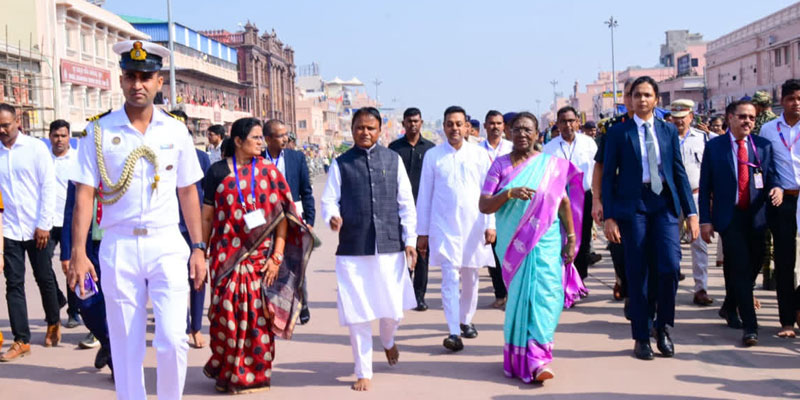
President Droupadi Murmu returned to her home turf in Odisha on February 4, 2026, inaugurating and laying foundation stones for development projects worth ₹284 crore in Rairangpur, Mayurbhanj district. The visit combined ceremony with substance: new facilities across health, education, sports and civic infrastructure were launched in the presence of Chief Minister Mohan Charan Majhi and local representatives. For a district with deep tribal roots and long-standing developmental gaps, the announcements marked both symbolic recognition and tangible investment.
A Home Visit with Purpose
Murmu’s visit carried emotional resonance as well as policy intent. Hailing from Mayurbhanj, she framed the projects as instruments of inclusive growth for a region historically on the margins of Odisha’s development trajectory. The initiative reflects a broader attempt to align local infrastructure expansion with the state’s long-term Vision 2036–2047 roadmap, while using the President’s connection to the district to mobilise public confidence and administrative urgency. Rather than a ceremonial homecoming, the programme functioned as a coordinated push to strengthen human development indicators in a predominantly tribal district.
Project Portfolio and Strategic Direction
The ₹284-crore package spans multiple sectors. A proposed AYUSH hospital and Ayurvedic college aims to expand healthcare access and promote traditional medicine. An extension campus of the Odisha University of Agriculture and Technology (OUAT) is expected to anchor agricultural research and skill training. Investments in an archery training centre, a women’s hostel, an auditorium and cultural complex, urban drainage upgrades, a de-addiction facility and an IT campus collectively target social infrastructure and quality of life in Rairangpur.
Taken together, these initiatives seek to transform the town into a regional service hub while strengthening links between rural tribal communities and institutional support systems.
How the Projects Could Reshape Tribal Livelihoods
Mayurbhanj’s population is overwhelmingly tribal, including Santal, Ho and Munda communities. The proposed interventions are designed to address persistent barriers in healthcare, education and employment.
· Healthcare Access:
The AYUSH hospital-cum-college is expected to blend traditional healing practices with modern treatment, reducing the need for long-distance travel for basic care. The de-addiction centre could address substance-abuse concerns among youth, a factor often linked to unemployment and social vulnerability in remote areas.
· Education and Skill Formation:
The OUAT campus and IT facilities may open pathways for tribal youth into agri-technology, forestry management and digital services. A 360-bed women’s hostel is likely to improve higher-education retention among girls by providing safe accommodation—an important step in narrowing gender gaps in education.
· Cultural and Sporting Opportunities:
The archery centre taps into indigenous sporting traditions, potentially converting cultural strengths into competitive and professional opportunities. The cultural complex can serve as a platform for preserving festivals, crafts and performing arts, while also supporting tourism.
· Urban and Economic Spillovers:
Civic upgrades such as drainage and beautification are expected to improve sanitation and market accessibility. Improved infrastructure could help connect tribal producers to markets for forest and agricultural products, enhancing income stability and reducing seasonal migration.
Symbolism Meets Structural Change
President Murmu’s visit to Rairangpur underscores how political symbolism can be leveraged to accelerate grassroots development. The ₹284-crore investment package is modest in scale compared to state-wide budgets, yet significant for a district like Mayurbhanj where targeted infrastructure can produce outsized social returns. If implemented effectively and accompanied by community participation, these projects could strengthen healthcare delivery, expand education access and create new livelihood pathways for tribal residents. The challenge ahead lies in sustained execution and local ownership—ensuring that this presidential homecoming translates into durable transformation for one of Odisha’s most culturally rich yet underserved regions.
(With agency inputs)