Russia’s latest large-scale aerial assault on Ukraine has once again exposed the vulnerability of the country’s air-defence network. The overnight barrage combined drones with cruise, ballistic and anti-ship missiles, killing at least eight people and damaging residential, industrial and transport infrastructure across several regions.
A War Defined by Long-Range Strikes
The Russia-Ukraine war has its roots in Russia’s seizure of Crimea in 2014 and the conflict involving Russian-backed forces in Ukraine’s Donbas region. On February 24, 2022, Russia launched a full-scale invasion, triggering Europe’s largest armed conflict in decades.
Ukraine resisted the initial Russian offensive and subsequently recaptured territory in several counteroffensives, while receiving extensive military, financial and intelligence support from Western countries. More than four years into the full-scale war, the conflict has evolved into a prolonged war of attrition involving artillery, drones, missiles and repeated attacks on critical infrastructure.
Russia Hits Ukraine with Drones and Missiles
According to Ukraine’s Air Force, Russia launched 130 drones, 48 cruise missiles and additional ballistic and anti-ship missiles during the latest overnight assault. Ukrainian forces said they destroyed or neutralised 161 targets, including:
· 117 drones;
· 39 cruise missiles; and
· Five ballistic or anti-ship missiles.
Despite the interceptions, strikes were reported at 18 locations, demonstrating the challenge of defending a large country against a coordinated, multi-vector assault.
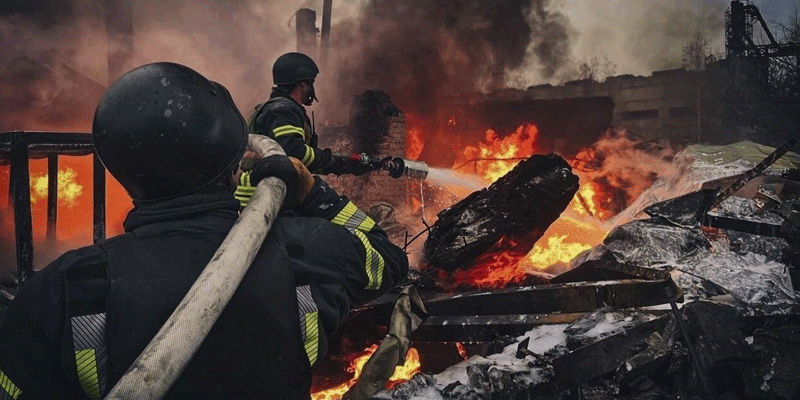
Kyiv, Poltava, Dnipropetrovsk and Kharkiv were among the areas targeted. In Pryluky in the northern Chernihiv region, a missile struck a five-storey residential building, killing at least four people and injuring around 20, including children and a police officer. Two people were also reported killed in Kyiv and two in Poltava, taking the immediate death toll to at least eight. Rescue operations continued at damaged sites, meaning the casualty count could still rise.
Civilian and Economic Infrastructure Under Pressure
The geographical spread of the attacks indicates that Russia’s campaign extends beyond battlefield positions. Regional authorities reported damage to an industrial facility in Dnipro, transport infrastructure in Zaporizhzhia and apartment buildings in Kremenchuk.
Such strikes create multiple layers of pressure by:
· Disrupting transportation and logistics;
· Damaging industrial capacity;
· Increasing economic costs;
· Threatening energy and essential infrastructure; and
· Maintaining psychological pressure on civilians far from the front line.
The Critical Battle Above Ukraine
Air defence has become one of Ukraine’s most important strategic requirements. The country faces shortages of interceptors, particularly systems capable of countering sophisticated ballistic threats. President Volodymyr Zelenskyy has said allied deliveries of air-defence missiles in 2026 had fallen to roughly one-third of the previous year’s level.
At the same time, Russia has expanded its use of faster jet-powered Shahed-type drones, adding another challenge for Ukrainian defenders. Saturation attacks are designed to overwhelm layered defence systems by forcing them to engage large numbers of relatively inexpensive drones alongside more sophisticated missiles.
Every Interceptor Carries a Strategic Cost
Ukraine’s forces demonstrated that they can still neutralise a substantial proportion of incoming weapons. But interception itself comes at a cost: every major barrage consumes valuable ammunition and forces commanders to determine which population centres and strategic facilities receive the strongest protection.
A War That Still Reaches Deep Behind the Front
The latest barrage reinforces a stark reality: even when territorial changes on the battlefield are limited, the war’s reach continues to expand through long-range attacks. Russia’s ability to combine drones and missiles is testing Ukraine’s defensive capacity, while each strike adds to the humanitarian and economic burden.
For Ukraine, sustaining effective air defence is therefore not simply a military necessity—it is essential to keeping cities functioning, protecting civilians and preserving the foundations of national resilience.
(With agency inputs)