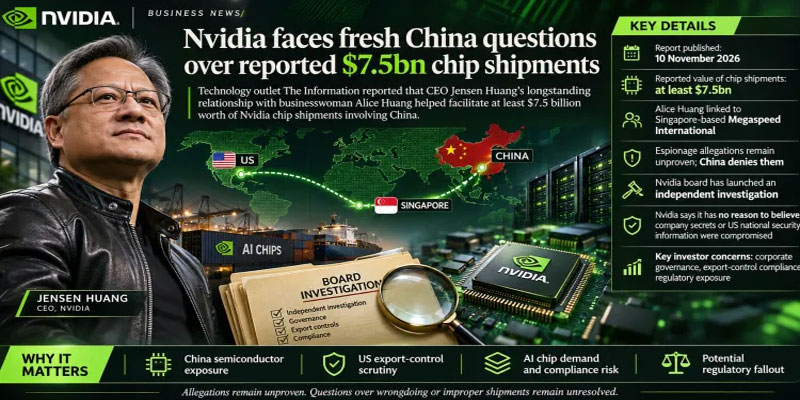
Nvidia faces mounting scrutiny over China's access to restricted AI processors and allegations involving CEO Jensen Huang. The controversy has intensified concerns about semiconductor export controls, corporate governance, and national security.
According to Reuters, Northwestern Polytechnical University, a Chinese institution linked to the People's Liberation Army, purchased two Nvidia H200 processors worth approximately $123,000 despite being on Washington's export blacklist.
The university reportedly acquired the processors through a domestic Chinese supplier. Procurement records also revealed contracts providing access to additional Nvidia chips through rented computing infrastructure, exposing potential weaknesses in export enforcement.
The H200 processors are critical for advanced AI training and inference. Although Washington permits certain exports to China under controlled licensing arrangements, blacklisted institutions remain subject to stringent restrictions.
Separately, Huang acknowledged an extramarital affair amid allegations that a woman connected to him was associated with Chinese intelligence. American authorities are reportedly examining potential security implications, while Nvidia has initiated an independent investigation.
Importantly, espionage allegations remain unproven. China has rejected the accusations, and no publicly established evidence demonstrates that Huang knowingly compromised American national security or facilitated unlawful semiconductor transfers.
The controversy has intensified congressional scrutiny of Nvidia's China strategy. Lawmakers are questioning whether advanced processors could strengthen Chinese military capabilities, particularly in autonomous systems, intelligence analysis, and defence-related AI applications.
The larger concern extends beyond Nvidia. As AI processors become strategic national assets, governments must strengthen semiconductor traceability, end-user verification, supply-chain transparency, and corporate accountability. The unfolding controversy demonstrates that technological leadership increasingly depends on protecting innovation against geopolitical vulnerabilities, regulatory failures, and potential intelligence exploitation.