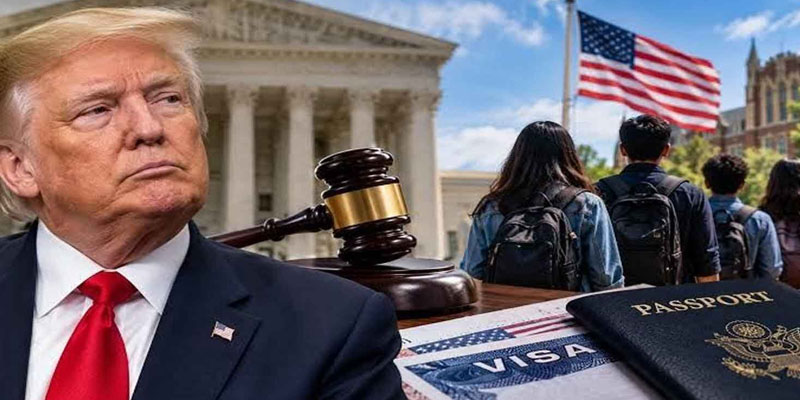
A US federal court has struck down the Trump administration's proposed restrictions on the duration of stay for international students, scholars, and foreign journalists, delivering a significant legal setback to its immigration policy.
On November 16, 2026, US District Judge F. Dennis Saylor in Boston ruled that the Department of Homeland Security's (DHS) proposed visa restrictions were arbitrary, capricious, and inconsistent with federal law.
The administration had proposed limiting international students holding F-1 visas to a maximum stay of four years, requiring additional federal authorization for those seeking to continue their education beyond that period.
The proposal also sought to restrict foreign journalists to 240 days in the United States, with a shorter 90-day limit for Chinese journalists.
Additionally, the government planned to reduce the post-study grace period from 60 days to 30 days and impose a cumulative 24-month limit on language training programmes.
Judge Saylor concluded that DHS lacked the broad statutory authority to undermine the educational opportunities Congress intended to provide through the F-1 visa programme.
The ruling preserves the longstanding Duration of Status framework, which generally allows eligible international students to remain in the United States while maintaining their authorized academic status.
The decision has been welcomed by Indian diaspora organizations and American higher education institutions, which argue that restrictive immigration policies could discourage international talent and weaken the country's research and innovation ecosystem.
The Foundation for India and Indian Diaspora Studies (FIIDS) described the judgment as an important safeguard for international students and America's technological competitiveness.
Education advocacy organizations, including NAFSA and the Presidents' Alliance on Higher Education and Immigration, also welcomed the decision, highlighting the importance of international students to universities, scientific research, and economic development.
The larger implication extends beyond immigration policy. International students contribute significantly to America's technology workforce, particularly in artificial intelligence, engineering, cybersecurity, and advanced research.
For Indian students, the judgment provides greater regulatory certainty, although broader immigration scrutiny and other visa requirements remain applicable.