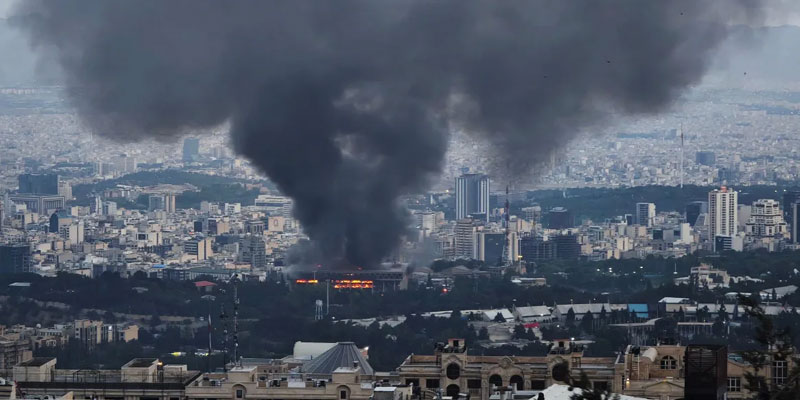
A Conflict Expanding Beyond Battlefields
US–Israeli strikes on Iran have entered a more volatile and consequential phase, with attacks reportedly hitting near the Bushehr nuclear power plant and targeting a major petrochemicals hub in Khuzestan. These developments mark a shift from conventional military engagements to strikes on infrastructure central to Iran’s energy network and economic resilience. As the conflict moves into its second month, the pattern is no longer episodic retaliation but a sustained campaign against strategic assets, raising the stakes for regional stability.
Bushehr Strike: Crossing a Nuclear Threshold
Iran’s Atomic Energy Organization confirmed that a projectile struck near the perimeter of the Bushehr nuclear facility, killing a member of the plant’s security unit. While the reactor itself and its core systems remain intact and operational, the incident is deeply symbolic. Reports indicate that this is the fourth time the broader Bushehr complex has been targeted during the ongoing conflict, highlighting its strategic and psychological importance.
The implications extend far beyond physical damage. Even a near-miss involving an active nuclear facility introduces the risk of radiological concerns, drawing scrutiny from international watchdogs and potentially violating long-standing norms against targeting nuclear infrastructure. Although no radiation leak has been detected, the repeated strikes amplify fears of escalation. Tehran has framed these actions as “nuclear blackmail,” a narrative that could justify stronger retaliatory measures and further harden its strategic posture.
Mahshahr Attacks: Economic Warfare Intensifies
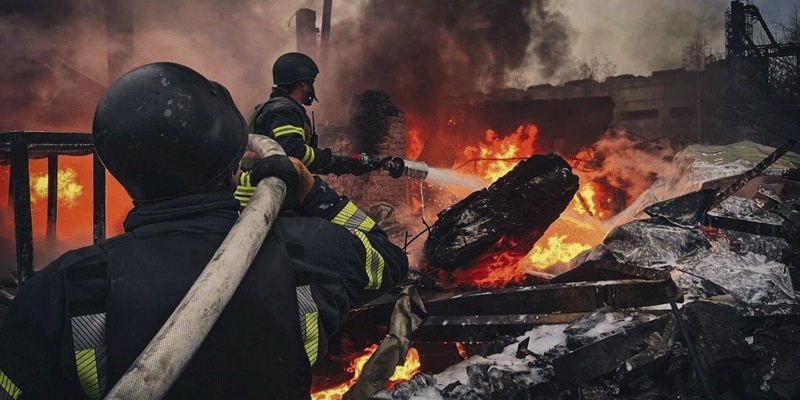
Almost simultaneously, explosions were reported in the Special Petrochemical Zone of Mahshahr in Khuzestan, one of Iran’s most critical industrial and export centers. Multiple facilities were reportedly hit, with casualties likely and the extent of damage still being assessed.
This shift toward targeting petrochemical infrastructure reflects a calculated attempt to weaken Iran’s economic backbone. Unlike crude oil facilities, petrochemical plants are deeply integrated into both export revenue streams and domestic industrial supply chains. Disrupting them not only constrains foreign exchange earnings but also impacts manufacturing and employment within Iran.
Moreover, such strikes carry broader regional implications. The Gulf’s energy ecosystem is highly interconnected, and attacks on major hubs risk unsettling global markets. Coupled with Iran’s own actions around the Strait of Hormuz, these developments heighten concerns over shipping security, insurance costs, and energy price volatility.
Escalation and Strategic Signalling
The strikes on Bushehr and Mahshahr illustrate a dual-pressure strategy: undermining Iran’s long-term strategic capabilities while signalling that no asset—military or civilian-adjacent—is beyond reach. What began as targeted operations against missile and drone infrastructure has evolved into a broader campaign against ports, industrial zones, and now nuclear-adjacent sites.
This trajectory raises critical questions about the erosion of conflict norms. Attacks on infrastructure that straddle civilian and strategic functions blur the line between military necessity and economic warfare. The risk is not only escalation between the primary actors but also spillover effects across the region, drawing in additional states and destabilizing already fragile supply chains.
A Precarious Balance on the Brink
The Bushehr and Mahshahr strikes underscore a dangerous inflection point in the conflict. By extending the battlefield into nuclear-adjacent and economic infrastructure, the war is no longer confined to tactical objectives but is reshaping the broader strategic landscape. The absence of immediate radiological fallout offers temporary relief, but the precedent set is deeply unsettling.
If such patterns persist, the conflict risks normalizing attacks on critical infrastructure, eroding international norms and increasing the probability of miscalculation. For the wider region—and for global stakeholders dependent on stable energy flows—the challenge is no longer just managing escalation, but preventing a systemic breakdown of the rules that have historically contained it.
(With inputs from agencies)