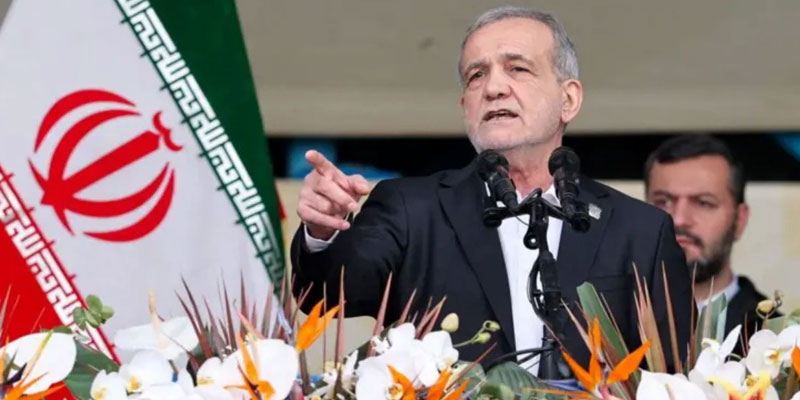
In a striking departure from conventional diplomacy, Iranian President Masoud Pezeshkian addressed an open letter directly to the people of the United States. Framed as an appeal for reflection amid the ongoing conflict, the letter bypasses official state channels and instead targets American public opinion. It comes at a time when tensions between Iran and the United States are escalating, signalling Tehran’s attempt to reshape the narrative of the war beyond the battlefield.
A Message Framed for the American Public
Pezeshkian’s letter is less about negotiation and more about persuasion. By directly addressing US citizens, he seeks to challenge the domestic consensus that underpins Washington’s military actions. Central to his argument is the claim that US involvement serves external interests—particularly those of Israel—rather than core American priorities. This framing attempts to tap into long-standing skepticism within the US about prolonged Middle East conflicts, questioning whether the war aligns with the “America First” principle championed by Donald Trump.
Recasting Iran’s Image Through Soft Power
Beyond geopolitical critique, the letter adopts a softer tone to humanise Iran. Pezeshkian emphasises that Iran holds no hostility toward ordinary Americans, highlighting cultural and professional links, including the contributions of Iranian-origin individuals in US academia and technology sectors. This effort to separate people from politics is a calculated soft-power move—designed to counter entrenched perceptions of Iran as a hostile state and instead present it as a civilisational actor seeking fairness and recognition.
Diplomatic Strategy: Information War and Public Pressure
From a diplomatic standpoint, the letter represents a shift toward information warfare. Unable to directly influence US policy through formal diplomatic channels, Tehran is attempting to shape the political environment in which those decisions are made. By appealing to public sentiment, Iran aims to widen the gap between government action and domestic tolerance for war. If successful, such messaging could increase political costs for Washington, potentially constraining its room for escalation.
However, the effectiveness of this approach is uncertain. The US political landscape remains deeply polarised, and messages originating from an adversarial state may be dismissed or even provoke counter-reactions. While the letter may resonate with segments already critical of foreign interventions, it is unlikely to produce immediate shifts in policy or public opinion.
Implications for the War
In the short term, the letter is unlikely to alter the trajectory of the conflict. Military calculations and strategic interests continue to dominate decision-making on both sides. Yet, its significance lies in the longer-term narrative battle. By attempting to influence how the war is perceived globally—and particularly within the US—Tehran is signalling that the conflict is as much about legitimacy as it is about military outcomes.
Diplomacy in the Age of Public Narratives
Pezeshkian’s outreach underscores an evolving dimension of modern conflict, where public opinion becomes a strategic arena. While its immediate impact may be limited, the letter reflects a broader effort to contest narratives and reshape perceptions. In a war defined by both force and messaging, such moves highlight that diplomacy today extends far beyond closed-door negotiations into the court of global public opinion.
(With agency inputs)