A Stark Warning to Corporate America
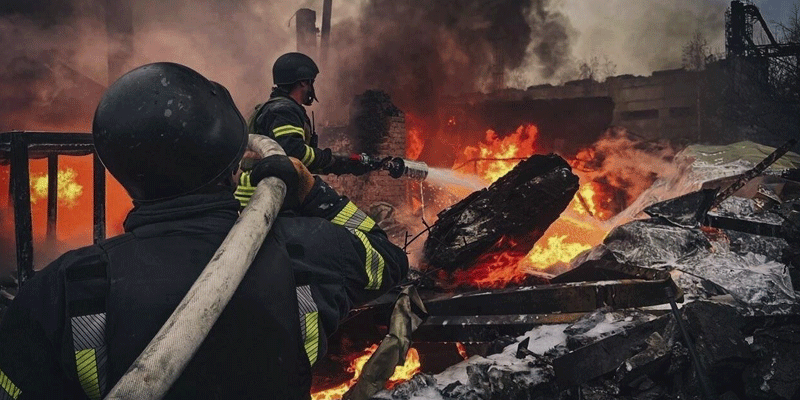
Iran has sharply escalated its confrontation with the United States, with the Islamic Revolutionary Guard Corps warning that it will target major American technology firms following what it calls the “targeted assassination” of its leaders. In an unprecedented move, the Guards named 18 companies—ranging from Big Tech to aerospace—alleging their complicity, and urged employees to evacuate offices ahead of potential strikes. The message is clear: corporate infrastructure is no longer off-limits.
Who’s in the Crosshairs
The list of companies spans critical sectors of the global economy. Tech giants like Microsoft, Google, Apple and Meta sit alongside semiconductor leaders such as Intel and Nvidia. Financial and industrial heavyweights—including JPMorgan Chase, Boeing and Tesla—also feature prominently.
By extending its accusations to regional players like G42, Iran is signalling that even indirect partnerships tied to US or Israeli intelligence ecosystems could be considered hostile.
Strategic Logic Behind the Threat
Iran’s framing reflects a fundamental shift: it views global technology firms not as neutral service providers but as enablers of US military and intelligence capabilities. From cloud computing and satellite data to AI analytics and financial systems, these companies are seen as part of a broader operational network.
The threat is designed as deterrence. By raising the cost of future assassinations—through potential disruption of corporate assets—Iran aims to influence Washington’s calculus without engaging in direct large-scale military confrontation. It also amplifies psychological pressure, targeting not just infrastructure but employee confidence and investor sentiment.
Likely Modes of Attack
From a capability’s perspective, Iran’s most credible tools lie in cyber warfare. Past incidents demonstrate its ability to disrupt banking systems, government networks and industrial operations. Cyber-attacks on data centres, cloud services, or regional offices in West Asia and Europe are plausible.
Physical actions—such as drone strikes or sabotage in accessible geographies like the Gulf—cannot be ruled out, though they carry higher escalation risks. Additionally, Tehran may leverage economic tactics, including sanctions, legal actions, or orchestrated boycotts in sympathetic markets.
Broader Implications and Risks
This development blurs the line between geopolitical conflict and corporate risk. Multinational firms may now need to reassess their exposure in volatile regions and reconsider the extent of their collaboration with defence and intelligence agencies.
However, the strategy carries risks for Iran. Targeting globally integrated companies could trigger strong retaliation, both cyber and potentially military, while also hardening Western public opinion. Moreover, the resilience and redundancy built into these corporations may limit the long-term damage Iran can inflict.
A New Era of Hybrid Conflict
Iran’s warning marks a turning point in modern conflict dynamics, where private corporations are drawn directly into state rivalries. As the battlefield expands from military targets to economic and technological systems, the stakes become more complex and far-reaching. The emerging reality is clear: in today’s interconnected world, geopolitical tensions are no longer confined to borders—they now run through the very infrastructure that powers the global economy.
(With agency inputs)