Four European Nations Back India’s Permanent UNSC Bid
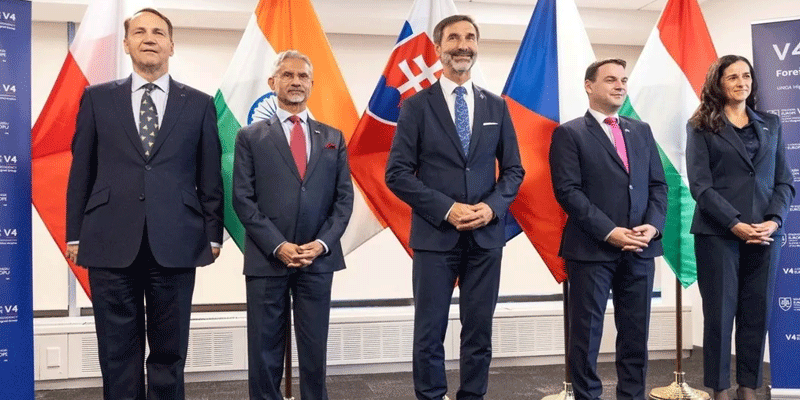
India’s campaign for a permanent seat on a reformed United Nations Security Council has received fresh collective backing from Hungary, Poland, Slovakia and the Czech Republic. The four Central European countries, known collectively as the Visegrad Group or V4, voiced support during the first V4–India foreign ministers’ meeting on the sidelines of the 81st UN General Assembly in New York.
India’s Long-Standing Case for UNSC Reform
The UN Security Council currently has 15 members, including five permanent members—China, France, Russia, the United Kingdom and the United States—and 10 non-permanent members elected for two-year terms. India has consistently argued that this structure does not adequately reflect today’s geopolitical, economic and demographic realities.
India is also part of the G4 grouping with Brazil, Germany and Japan, which supports expansion of permanent and non-permanent membership. However, reform requires broad agreement among UN members and amendments to the UN Charter, making the process politically complex.
V4 Countries Put Their Support on Record
The latest endorsement is significant because it represents a collective position from four European countries rather than separate bilateral expressions of support.
Slovak Foreign Minister Juraj Blanár said the V4 countries agreed that India, as part of the Global South and an emerging Indo-Pacific power, should have a permanent place at the Security Council.
For New Delhi, the backing adds another European grouping to its diplomatic campaign while reinforcing its argument that the UN’s decision-making structures need broader representation.
A Wider India–V4 Partnership Takes Shape
· Annual foreign ministers’ meetings to maintain sustained political dialogue.
· An annual business forum to expand trade and investment.
· Greater defence cooperation, including efforts to build on existing defence relationships.
· Stronger technology, innovation, research and education partnerships.
· Expanded cooperation in space, connectivity, culture and people-to-people exchanges.
The discussions also covered major international developments, including the Ukraine conflict and developments in the Gulf.
Central Europe Adds a New Diplomatic Dimension
The V4 endorsement gives India another platform for engagement with Central Europe at a time when New Delhi is broadening its European partnerships. For the four V4 countries, closer engagement with India provides opportunities in technology, manufacturing, defence, trade and connectivity while strengthening links with a major Indo-Pacific economy.
However, the endorsement does not itself alter the formal UNSC reform process. Questions surrounding the number of new permanent members, regional representation and whether new permanent members should receive veto powers remain unresolved.
Support Builds Momentum, But Reform Requires Consensus
The V4 backing strengthens the diplomatic breadth of India’s permanent-membership campaign, while the newly established annual dialogue gives the relationship a more institutional foundation. Yet UNSC reform remains a multilateral negotiation requiring agreement across the wider UN membership and the existing permanent members.
The immediate significance, therefore, lies not in an imminent change to the Council’s structure, but in the growing number of governments publicly supporting a more representative global security architecture—and India’s increasingly structured engagement with Europe to advance that case.
(With agency inputs)