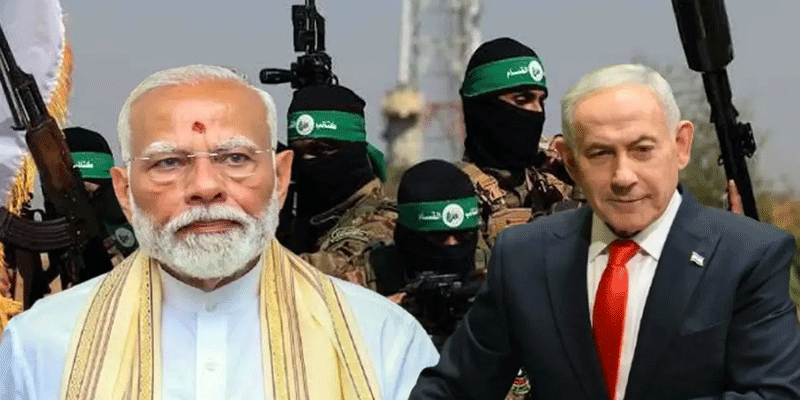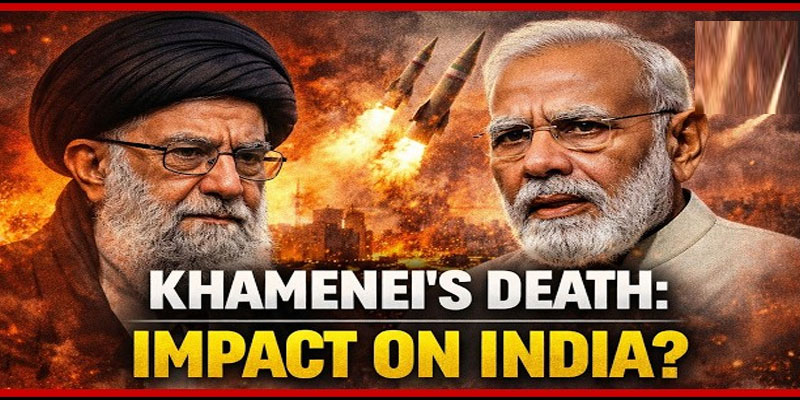
In the aftermath of Ayatollah Ali Khamenei’s killing, India’s response has been marked by notable restraint. New Delhi has neither condemned nor condoned the US–Israel action, choosing instead to focus on calls for de-escalation. This calibrated silence reflects a calculated, interest-driven neutrality—one designed to preserve India’s complex web of regional partnerships while aligning subtly with the broader democratic mood that views Khamenei less as a statesman and more as an authoritarian figure.
India’s Official Line: De-Escalation Over Judgment
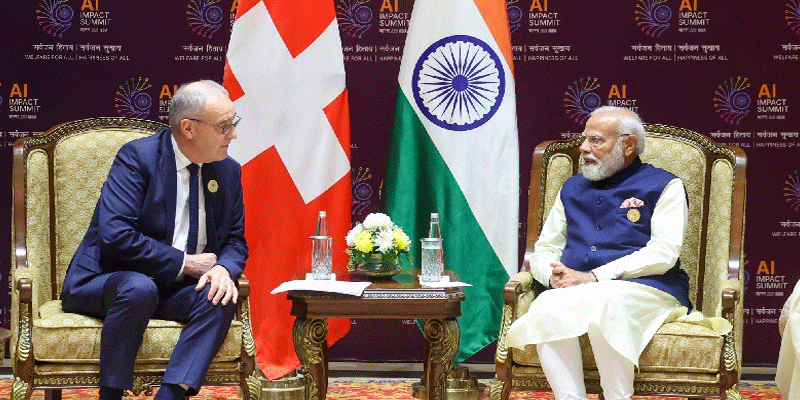
The Ministry of External Affairs and Prime Minister Narendra Modi have framed the West Asia crisis as “a matter of grave concern,” urging restraint, dialogue, and diplomacy. During a joint briefing with Canadian Prime Minister Mark Carney, Modi reiterated India’s commitment to peaceful resolution and safeguarding Indian nationals in the region.
Importantly, India has condemned Iranian missile and drone attacks on partners such as the UAE but has avoided passing any value judgment on Khamenei’s death itself. This careful phrasing allows India to focus on stability and citizen safety without endorsing regime change or validating Tehran’s leadership.
Global Democratic Mood: No Condolences from the G7
A central factor shaping India’s stance is the broader international response. No G7 democracy has issued a condolence message. Instead, several leaders characterized Khamenei in starkly negative terms.
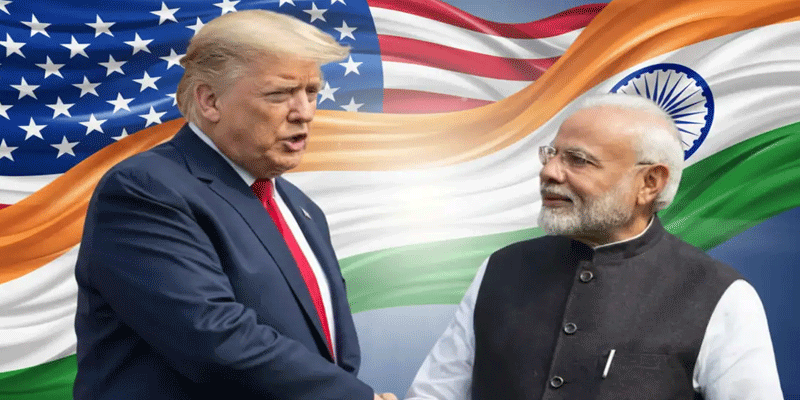
US President Donald Trump described him as “one of the evillest people in history” and framed his death as an opportunity for Iranians to reclaim their country. Israeli Prime Minister Benjamin Netanyahu declared, “Justice has been served.” Argentina’s Javier Milei called him “one of the most evil, violent, and cruel persons ever,” while Ukraine’s official account stated, “Nothing beats the death of a dictator.”
UK Defence Secretary John Healey remarked that few would mourn the head of an “evil regime.” Australia’s Anthony Albanese emphasized Iran’s destabilizing missile and proxy activities. France’s government spokesperson noted Paris could “only be satisfied with his demise.” Carney himself termed Iran “the principal source of instability” in the Middle East.
In this context, an Indian condolence message would have sharply diverged from its G7 partners and risked denting its democratic credentials.
Balancing Gulf Interests and Eurasian Ties
At the same time, India cannot afford overt celebration. Gulf nations—home to over nine million Indian expatriates and critical to India’s energy security—have either condemned Iranian retaliatory strikes or maintained guarded silence. The UAE withdrew its ambassador from Tehran after being targeted; Saudi Arabia convened a GCC emergency session. Alienating these partners would carry economic and strategic costs.
Simultaneously, Russia has labeled the US–Israel strikes “pre-planned armed aggression,” and China has called for restraint. India’s multi-alignment strategy—bridging the West, Russia, China, and the Gulf—necessitates a narrow diplomatic lane focused on stability rather than moral endorsement.
Domestic Considerations and Political Calculus
Domestically, the Iranian embassy in Delhi urged governments to condemn the killing, while some opposition voices criticized Modi’s silence. Yet many Muslim-majority governments have stopped short of formal mourning, softening domestic pressure. A sharp statement either way could polarize opinion without yielding tangible diplomatic benefits.
Principled Pragmatism in Action
India’s response—no condolences, no applause—embodies its doctrine of “principled pragmatism.” By emphasizing peace, stability, and the protection of its diaspora, New Delhi signals that Khamenei’s demise is not India’s battle. Its priority is preventing a wider regional conflagration that could threaten energy flows, expatriate safety, and economic stability. In an era of polarized geopolitics, strategic silence can be as deliberate—and as consequential—as speech.
(With agency inputs)