Border Security, Connectivity and Bilateral Ties in Focus
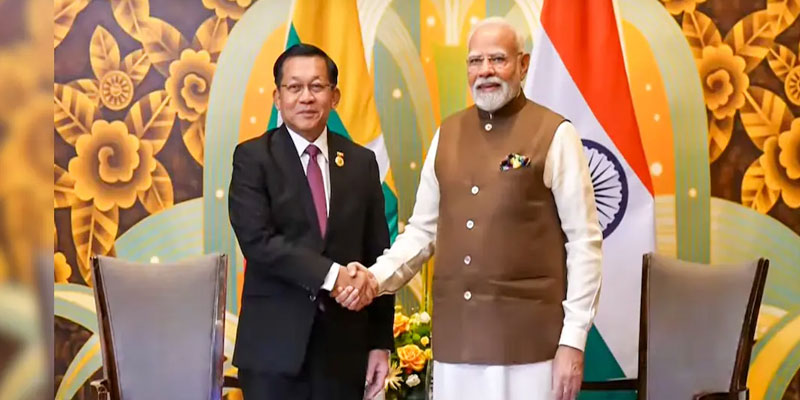
Myanmar President U Min Aung Hlaing’s five-day visit to India from May 30 to June 3 has attracted significant attention in diplomatic and strategic circles. As his first foreign visit since assuming office as Myanmar’s civilian president following recent elections, the trip underscores the importance both countries attach to strengthening bilateral relations. Beginning in Bodh Gaya, one of Buddhism’s holiest sites, the visit also highlights the deep civilisational and cultural links that have long connected India and Myanmar. Beyond symbolism, however, the visit is expected to focus on pressing issues such as border security, connectivity, trade and regional geopolitics.
A New Chapter in India–Myanmar Relations
The visit comes during a period of political transition in Myanmar. U Min Aung Hlaing, who led the military government after the 2021 coup, now heads a civilian administration following parliamentary elections. His decision to make India his first foreign destination reflects the strategic importance of the relationship.
For India, Myanmar occupies a unique position in its foreign policy architecture. It is the only Southeast Asian country that shares both a land and maritime boundary with India, making it a crucial link between South Asia and the wider ASEAN region. Consequently, Myanmar features prominently in India’s “Neighbourhood First,” “Act East” and MAHASAGAR (Mutual and Holistic Advancement for Security and Growth Across Regions) initiatives.
Why Border Security Remains Central
One of the most important issues on the agenda is border management. India and Myanmar share a 1,640-kilometre border stretching across Arunachal Pradesh, Nagaland, Manipur and Mizoram. Several of these regions have experienced insurgent activity over the years, with militant groups often exploiting the porous frontier.
Enhanced cooperation between the two countries is therefore vital for intelligence-sharing, coordinated security operations and curbing cross-border movement of armed groups, weapons and illicit trafficking networks. Stability along this border is directly linked to peace and development in India’s Northeast.
Connectivity and Economic Integration
Connectivity is another key pillar of the relationship. India views Myanmar as its gateway to Southeast Asia, making infrastructure projects strategically important.
Projects such as the India–Myanmar–Thailand Trilateral Highway and the Kaladan Multi-Modal Transit Transport Project are expected to feature prominently in discussions. These initiatives aim to improve trade, reduce logistical barriers and integrate India’s northeastern states with regional markets. Stronger connectivity could also boost tourism, investment and people-to-people exchanges between the two countries.
Strategic Balancing in the Indo-Pacific
The visit carries broader geopolitical significance as well. Myanmar occupies a strategic location between South and Southeast Asia and has long been an arena of competition among major powers. China has established substantial economic and political influence in Myanmar through infrastructure investments and strategic projects.
By deepening engagement with Myanmar, India seeks to strengthen its own regional presence, diversify Myanmar’s partnerships and advance its interests in the Bay of Bengal and Indo-Pacific regions. The relationship also holds potential for cooperation in energy, critical minerals and maritime security.
A Partnership Shaped by Geography and Strategy
President Hlaing’s visit represents more than a routine diplomatic engagement; it reflects the convergence of security, economic and geopolitical interests. For India, closer ties with Myanmar are essential for securing its northeastern frontier, advancing regional connectivity and maintaining strategic balance in the Indo-Pacific. For Myanmar, engagement with India offers opportunities for economic cooperation and broader regional integration. The outcomes of this visit could therefore shape the trajectory of bilateral relations and regional dynamics for years to come.
(With agency inputs)