A New Strategic Chapter Begins
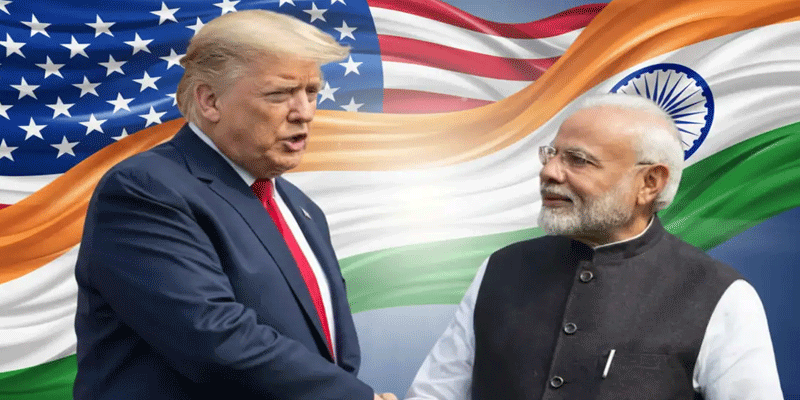
In a major stride for global defence cooperation, India and the United States signed a 10-year Defence Framework Agreement on October 31, 2025, marking a new phase in one of the world’s most critical strategic partnerships.
Announced jointly by US Secretary of War Pete Hegseth and Indian Defence Minister Rajnath Singh during the ASEAN Defence Ministers’ Meeting in Kuala Lumpur, the pact deepens collaboration in intelligence sharing, defence technology, and joint military operations.
Hegseth called it a “cornerstone for regional stability and deterrence”—a statement reflecting how both democracies see the Indo-Pacific not just as a theatre of competition, but as a space for shared responsibility and strategic balance.
From Trust-Building to Strategic Alignment
The 2025 framework builds on a strong legacy of defence cooperation that has steadily matured over two decades.
· 2005: The first Defence Framework Agreement laid the foundation for dialogue and joint training.
· 2012: The Defence Trade and Technology Initiative (DTTI) strengthened industrial and technology cooperation.
· 2016: India became a Major Defence Partner (MDP)—a unique designation placing it alongside America’s closest allies.
· 2016–2020: Foundational pacts enhanced logistics, intelligence sharing, and interoperability.
· 2023: PM Modi’s US state visit saw the signing of major defence production deals—F-414 jet engines and MQ-9B drones—cementing tech-driven collaboration.
This evolution has transformed the relationship from transactional defence trade to strategic interoperability, built on trust, technology, and shared democratic values.
Inside the New 10-Year Defence Framework
The newly signed pact goes far beyond routine cooperation, setting a comprehensive blueprint for the next decade:
· Real-Time Intelligence Sharing: Secure, streamlined communication channels for counterterrorism and maritime surveillance.
· Technology Transfer: Accelerated sharing of advanced systems—AI in warfare, missile guidance, avionics, and drone innovation.
· Joint Military Exercises: Institutionalized tri-service drills to enhance tactical readiness and interoperability.
· Maritime Collaboration: Coordinated patrols and strategic communication to maintain freedom of navigation in the Indo-Pacific, a subtle counter to China’s growing assertiveness.
Regional and Strategic Implications
The agreement’s timing is significant. It comes amid heightened US-China rivalry, a revived Russia-China axis, and regional turbulence across the Indo-Pacific.
For Washington, India represents a strategic anchor—a democratic counterbalance in Asia. For New Delhi, deeper alignment with the US bolsters deterrence across its northern and maritime frontiers, reinforcing India’s security calculus against China-Pakistan coordination.
By embedding the partnership within frameworks like the Quad (India, US, Japan, Australia), both nations signal a shared commitment to a “free, open, and rules-based Indo-Pacific.”
Defence Industry Synergy and Economic Opportunity
The framework seamlessly aligns with India’s “Make in India” and “Aatmanirbhar Bharat” visions. It opens new avenues for:
· Joint R&D and co-production of advanced weapon systems.
· US investment in India’s defence innovation ecosystem.
· Reduced import dependence through localized technology transfer.
Rajnath Singh hailed it as “ushering in a new decade of partnership”—a pathway toward both enhanced national capability and regional stability.
Challenges and the Road Ahead
The partnership is not without friction points. US export controls, data security norms, and India’s industrial absorption capacity remain practical challenges. Additionally, Pakistan’s criticism and China’s regional posturing may test diplomatic finesse.
Yet, the political will on both sides and the clear alignment of long-term strategic goals ensure the pact’s durability.
A Partnership for a Shared Future
The India–US 10-Year Defence Framework is more than a diplomatic milestone—it’s a strategic vision for the Indo-Pacific’s stability. By combining defence modernization with mutual trust, it charts a path toward stronger deterrence, technological advancement, and regional peace.
As the two democracies deepen their collaboration, this agreement stands as a defining statement: the Indo-US partnership is no longer just about cooperation—it’s about co-creation of security, innovation, and global balance in an increasingly uncertain world.
(With agency inputs)